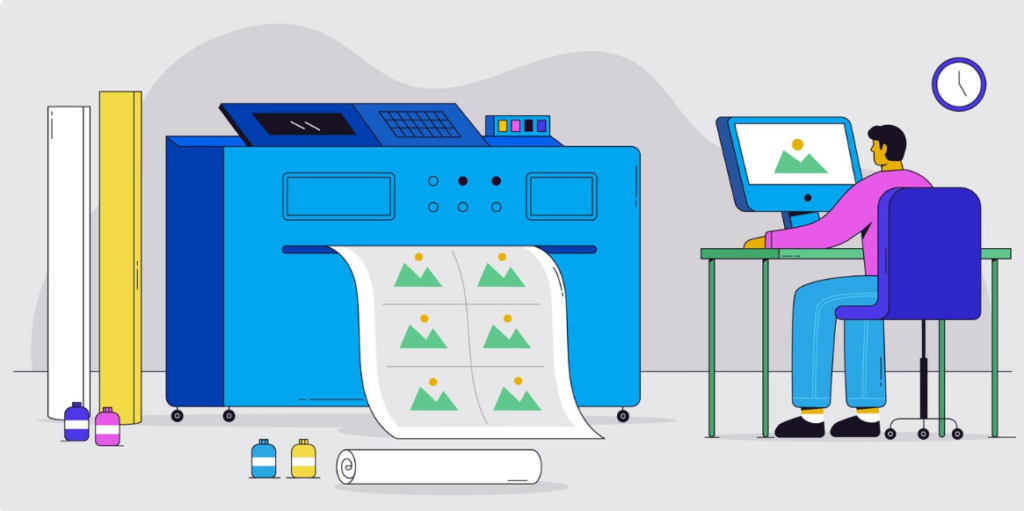
A sticker seems like the least futuristic object on Earth. Peel, stick, done. It’s the kind of thing you’d hand a toddler, not something you’d expect to show up in a conversation about technology.
But look closer at how a modern custom sticker gets made, and you find a surprising stack of tech: digital printing that didn’t exist at this price a generation ago, materials engineered to survive water and sun, web software that turns your laptop into a print shop, and now tiny chips that let a sticker talk to your phone. Custom stickers have quietly ridden the same wave of cheap computing and on-demand manufacturing that reshaped almost everything else.
Here’s what’s going on inside that little square.
The Printing Tech That Changed Everything
For most of the last century, printing anything in color meant offset presses. Great for huge runs, terrible for small ones. Setting up a job was expensive, so printing 50 stickers cost almost as much per unit as printing 50,000. Small orders just weren’t worth anyone’s time.
Digital printing flipped that. Modern inkjet and laser systems print straight from a file, no plates, no lengthy setup, which means a run of 25 stickers is suddenly cheap and fast. Pair that with digital die-cutting, where computer-controlled cutting systems follow virtually any outline the software provides, and you can cut a sticker into any shape without a custom metal die. Want 30 stickers shaped like your dog’s face? That’s a five-minute job now, not a manufacturing project.
This one shift is the reason “custom” stopped being a luxury.
Order Online, Get Stickers in Days
The other half of the story is software. Web-to-print, the tech industry calls it. You upload artwork in a browser, see a preview, pick a size and finish, and the order routes straight to a printer that may be on another continent. A few days later a package shows up. No phone calls, no proofs faxed back and forth, no minimum order of a thousand.
Design got easier too. Plenty of platforms now bundle templates and AI-assisted tools that clean up a blurry logo or cut the background out of an image automatically, so you don’t need to know your way around professional design software to get something that looks sharp. A good custom sticker company handles the messy parts, color profiles, bleed, cut lines, in the background, and you see the finished result.
It’s the same on-demand model that changed books and t-shirts. Stickers were just a little slower to get there.
Materials Science You Don’t Think About
A sticker is a tiny sandwich: a printed face, a protective top layer, an adhesive, and a backing. Each layer is doing a job.
The face is usually paper for indoor use or vinyl for anything that needs to last. Add a laminate on top and the thing shrugs off water, scratches, and sun without fading. The adhesive is its own small field of chemistry: some are built to grip hard and stay forever, others to peel off cleanly months later without leaving residue. There’s a real difference between a sticker that survives a year on a water bottle and one that curls up after a week, and most of that difference is the materials.
Some manufacturers have begun experimenting with recyclable backings, recycled materials, and alternative films as demand for more sustainable packaging grows. It’s far from standard, but the option is there now where it mostly wasn’t before.
The Smart Sticker Era
This is where stickers start looking like gadgets.
The simplest version is the QR code, which you already see everywhere. It’s older than most people think. The QR code was invented back in 1994 by the Japanese company Denso Wave to track car parts on assembly lines, and because it can hold far more data than a regular barcode and still scan when it’s scuffed or partly covered, it aged into the perfect bridge between a printed sticker and a web page. Slap a QR sticker on a product and a phone camera turns it into a link, a video, a coupon, whatever you’ve set it to open.
The next step up adds a chip. NFC, the same tap-to-pay tech in your phone, can be built into a sticker as a thin, battery-free tag. The NFC Forum describes it as short-range wireless that works at a tap from a couple of centimeters away. Tap your phone to an NFC sticker and it can open a site, prove a product is authentic, or pull up instructions, no app required. A sticker that used to just sit there now does something.
The uses run well past marketing, though. Smart stickers are turning up in logistics and inventory systems, in anti-counterfeiting tags that let a buyer check a product is the real thing, and in connected packaging that ties a physical item to its digital record. As NFC chips and printed electronics continue to become more affordable, stickers are increasingly being used as a simple way to connect physical objects with digital information.
Still Just a Sticker, Technically
None of this changes what a sticker is for. It still labels a jar, brands a laptop, seals a box, makes a kid happy. The job is the same as it was a hundred years ago.
What changed is everything behind it: the printing got cheap, the ordering got instant, the materials got tough, and the smartest ones picked up a digital pulse. For something you can buy by the dozen and stick to a notebook, that’s a strange amount of technology for something so small. And the chips are only getting cheaper, so the sticker on your next package might do more than you’d guess.