Introduction
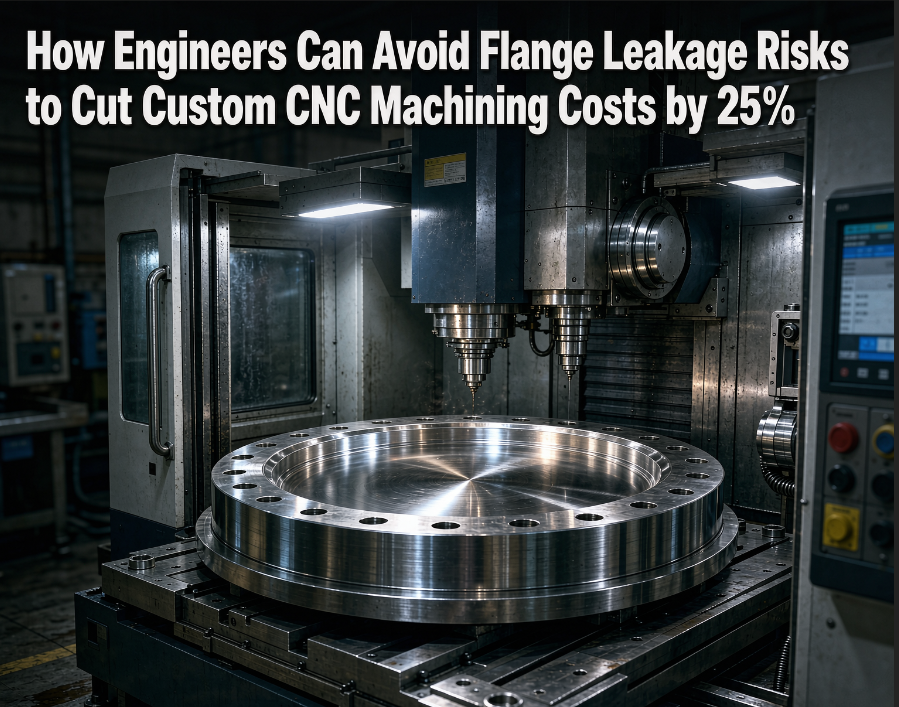
Deviation of flange sealing surfaces in modern industrial pressurized systems and precise fluid transmission systems will often lead to the leakage of the media, which will result in very expensive shutdown maintenance costs. Conventional flange machining techniques often ignore the integrated optimization of surface finish (Ra value), geometric dimensioning and tolerancing (GD&T), and stress release of material, which results in early failure.
In this article, the technical challenges of precise machining of flange sealing surfaces are analyzed, advanced five-axis machining methods are explored, and cost optimization techniques are presented. By thoroughly analyzing the process basics, engineering teams can achieve zero-leakage sealing performance while minimizing the cost of production.
1: Why Is Precision Flange Machining Essential for Zero-Leakage Industrial Systems?
The flange surfaces under high-pressure conditions suffer from complicated stress distribution that impacts the sealing effect. The flatness and coaxial tolerance of the surfaces will impact the uniformity of compression force on the gaskets.
1. Understanding Flange Face Stress Mechanisms Under Pressure
Increased internal pressures cause elastic and plastic deformations of flange faces, affecting contact stress distribution between them. Such uneven distribution may lead to either over-compression or under-compression of the gasket, thus creating possible leaks. Engineers performing precision flange machining need to be aware of these deformations to set up suitable surface finish specifications and flatness requirements.
2. Impact of Geometric Tolerances on Sealing Performance
Geometric tolerances such as flatness and perpendicularity define the evenness of the distribution of loads during the seating of the gasket. There are explicit provisions in the ASME Y14.5 Dimensioning and Tolerancing standard allowing engineers to define specific requirements for uniform load distribution and therefore uniform gasket compression.
3. Challenges with Traditional Machining of Difficult Alloys
Interrupted cutting in the conventional three-axis machining process of materials like stainless steel, Inconel, and titanium alloys leads to surface tearing and improper chip removal. These issues lead to the formation of micro-channels that are not sealed by the gaskets. In order to achieve industrial precision manufacturing in the flange manufacturing process, the use of optimum tool geometries and climb milling techniques removes the surface defects, thereby affecting flange CNC machining cost.
2: How Do Modern Engineers Optimize Custom Flange Face CNC Machining Parameters?
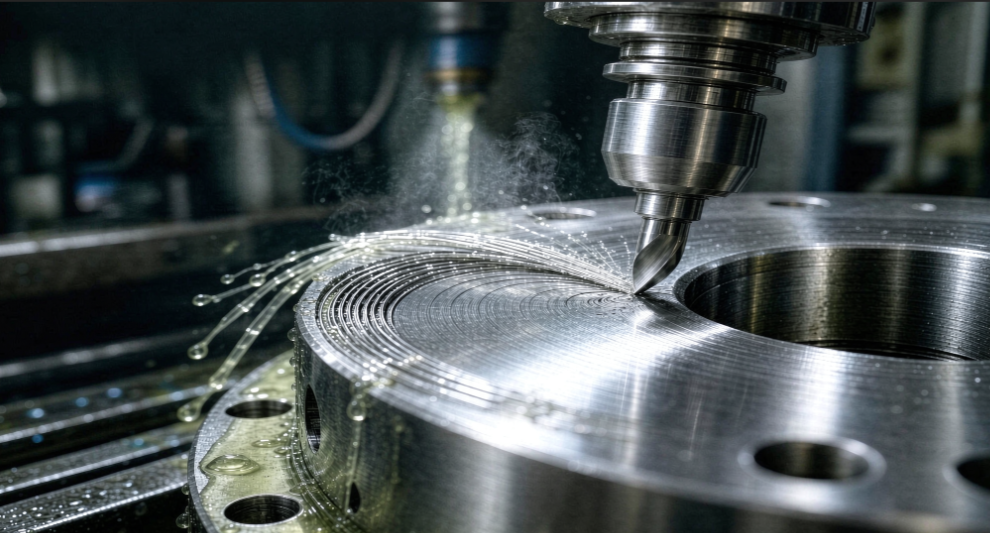
Parameters such as tool path planning, cutting speed, feed rate, and cooling fluid selection influence the texture of the final sealable surface. Parameter optimization helps increase the life of the tools, as well as decrease part cycle time.
1. Tool Path Planning for Desired Surface Texture
Concentric spiral paths provide consistent surface finish for sealing without any changes in surface roughness, whereas radial path leaves some direction on the surface that causes leakages. The optimum cutting toolpaths and surface roughness in the industrial level need engineering knowledge that is described in this analysis of custom flange face CNC machining.
2. Cutting Speed and Feed Rate Optimization
Higher cutting speed with moderate feed rate leads to improved surface finish because it avoids the creation of built-up edge. The engineers select the combinations of parameters that enable surface finish optimization, which can be done at Ra 1.6 µm within one pass.
3. Coolant Selection and Application Strategy
The high-pressure coolant system with spindle delivery cleans chips from the cutting zone and avoids chip re-cutting that negatively influences surface integrity. By using these custom CNC flange solutions it is possible to avoid thermal deformations and increase insert durability, thus reducing production cost.
3: When Should Manufacturers Implement 5-Axis CNC Machining for Complex Flanges?
Three axis machining cannot handle sealing faces which have an angle and complex shapes of flanges as a number of fixturing setups are needed for machining. Five axis single-setup technology does not have such a disadvantage.
- Efficiency Comparison: Three-Axis vs. Five-Axis Machining: 3-axis machining requires a number of fixturing setups as well as manual positioning of compound angles with positional tolerances of up to 0.05 mm each time. 5-axis CNC machining allows performing the task with only one setup increasing accuracy and decreasing handling time by 40-60%.
- Single-Setup Advantages for Concentricity Control: Performing all machining operations (sealing faces, bolt holes, back faces) with a single program in a five-axis system helps to avoid stack-up tolerance error between operations. Such advanced CNC machining solutions allow keeping concentricity up to 0.01 mm which is important for high-pressure sealing applications.
- Cost Implications of Multi-Axis Technology Adoption: Although the initial cost of 5-axis equipment is higher, saving in secondary operations and lower scrap rates result in quick payback. Professional CNC flange facing service companies use the technology to provide good prices for complicated flange designs.
4: What Strategies Help Reduce Custom Flange Manufacturing Costs Without Sacrificing Quality?
DFM techniques ensure that cost reductions are achieved in a systematic way without compromising on functionality.
1. Material Utilization Optimization
Choosing near-net-shaped blanks and using several parts from one blank saves up to 15-25% of material usage. In the custom flange manufacturing, bar stock material should be used in standard sizes to avoid paying for premium material.
2. Strategic Tolerance Allocation
By choosing loose tolerance in secondary dimensions such as OD and back face flatness, machining process time is reduced without affecting sealing functionality. ISO 9001 QMS can be used as a tool for documenting this choice; therefore, companies will be able to control their tolerance deviation without compromising functionality while saving money.
3. Prototyping vs Production Cost Structures
The usage of rapid prototyping services during the first phase of design enables performing design testing with reduced costs and simpler fixturing processes. Once the design has been validated, investing in manufacturing equipment becomes reasonable. The presence of a reliable flange machining quote by various manufacturers would enable cost savings.
5: How Can Digital On-Demand Platforms Accelerate Industrial Flange Procurement?
Digital platforms provide automation of DFM analysis and price estimation, allowing for the reduction of procurement processes from weeks to days.
- Automated DFM Analysis for Design Validation: Online tools verify parts’ geometry regarding manufacturing limitations, indicating thin walls, deep pockets, and sharp corners during the quoting process.
- Real-Time Quoting and Lead Time Reduction: In order to simplify manufacturing processes, more engineering departments depend on online CNC machining services that provide real-time DFM analysis and fast quotations for high-precision parts. Digital technology eliminates the time needed for manual quotations.
- Supplier Certification Assessment: Certified suppliers such as those with ISO 14001, ISO 9001, IATF 16949, AS9100D certifications prove their dedication to maintaining the highest quality standards for any material family used. The manufacturer shows how certified providers use their technical skills along with responsive customer service.
Conclusion
The production of high quality sealing surfaces depends on a range of factors from optimized design to tolerance specification and modern cutting processes. By eliminating myths associated with manufacturing processes and using standardized quality control systems, industry players will not only increase reliability but save over 25% on the cost.
FAQs
Q1: What is the ideal surface roughness for a CNC machined flange face?
A1: The optimal surface roughness of the standard serrated flange face varies between Ra 3.2 to 6.3 µm, while the sealing surfaces should have surface roughness of Ra 1.6 µm or less.
Q2: How does 5-axis CNC machining improve custom flange manufacturing?
A2: 5-axis CNC machining allows to perform complex designs of flanges and cut angled sealing faces in one operation without positioning errors, increases concentricity and saves machining time.
Q3: Why are geometric tolerances critical in precision flange machining?
A3: Flatness and Perpendicularity tolerances are used to avoid uneven stress on sealing gaskets and thus greatly minimize mechanical stress, deformation, and the risk of leakage of pipelines.
Q4: How can engineers reduce costs during the flange prototyping stage?
A4: The following techniques can be used to reduce costs: the application of DFM principles, loosening of tolerances where possible, using standard sizes of raw materials, and on-demand rapid prototyping.
Q5: Which quality standards should custom flange manufacturers maintain?
A5: Leading manufacturers possess ISO 9001 certification for quality management systems, IATF 16949 for automotive standards, AS9100D for aerospace compliance, and ISO 14001 to produce standardized, highly precise results.
Author Bio
The engineering research team at LS Manufacturing is known for its expertise in manufacturing precision parts for the aerospace, automotive, and medical fields. It assists engineering teams in solving difficult sealing and tolerance issues in high pressure fluid systems. We are a company that is ISO 9001, ISO 14001, IATF 16949, and AS9100D certified to provide quality and timely products. Need to optimize your high-pressure component designs? Contact LS Manufacturing today to get an instant DFM analysis and a custom flange machining quote.