Cooling a large production hall or warehouse with traditional air conditioning is rarely the most sensible choice. The spaces are too big and the heat loads too high, so the energy bill grows faster than the comfort does. For many industrial buildings, cooling based on water evaporation is a better fit, because it handles large volumes of air at a fraction of the energy cost.
Why Heat Builds Up Faster Than You Think
Industrial buildings collect heat from multiple directions at once. Process equipment such as ovens and compressors releases warmth into the space all day. Add solar gain through a large flat roof and the indoor temperature can climb well above the outdoor temperature by mid-afternoon.
That heat comes at a real cost. Employees slow down and make more mistakes when temperatures rise above comfortable levels. Temperature-sensitive products and processes suffer too, such as chocolate in a food facility or tight tolerances in metalworking. In the worst case, heat stress can lead to health incidents on the shop floor.
The Problem With Scaling Up Air Conditioning
Mechanical air conditioning works well in offices. In a hall of tens of thousands of square feet, it runs into limits. Compressor-based systems consume a lot of electricity, and that consumption peaks on hot days, exactly when the grid is under the most strain. Many sites simply don’t have the electrical capacity to cool the entire building this way.
There is also the question of air quality. Most air conditioning recirculates indoor air to save energy. In a production environment full of dust or fumes, recirculating that same air keeps contaminants inside the building instead of removing them.
A Different Principle: Cooling With Water Instead of Refrigerants
Evaporative cooling, also called adiabatic cooling, takes a different route. It uses the same mechanism your body uses when you sweat: water evaporates, and that evaporation extracts heat from the air, cooling it down. No chemical refrigerants, no heavy compressors.
The practical advantages for large buildings are significant. The system works with 100% fresh, filtered outside air, so stale indoor air is continuously pushed out instead of recirculated. And because the main energy input is a fan rather than a compressor, electricity consumption drops sharply compared to conventional air conditioning.
The Humidity Question and the Two-Stage Answer
The common objection to evaporative cooling is humidity. A simple direct system adds moisture to the air it supplies. For some buildings that’s fine; for others, such as facilities with packaging lines or paper handling, added humidity can cause real problems with materials and product quality.
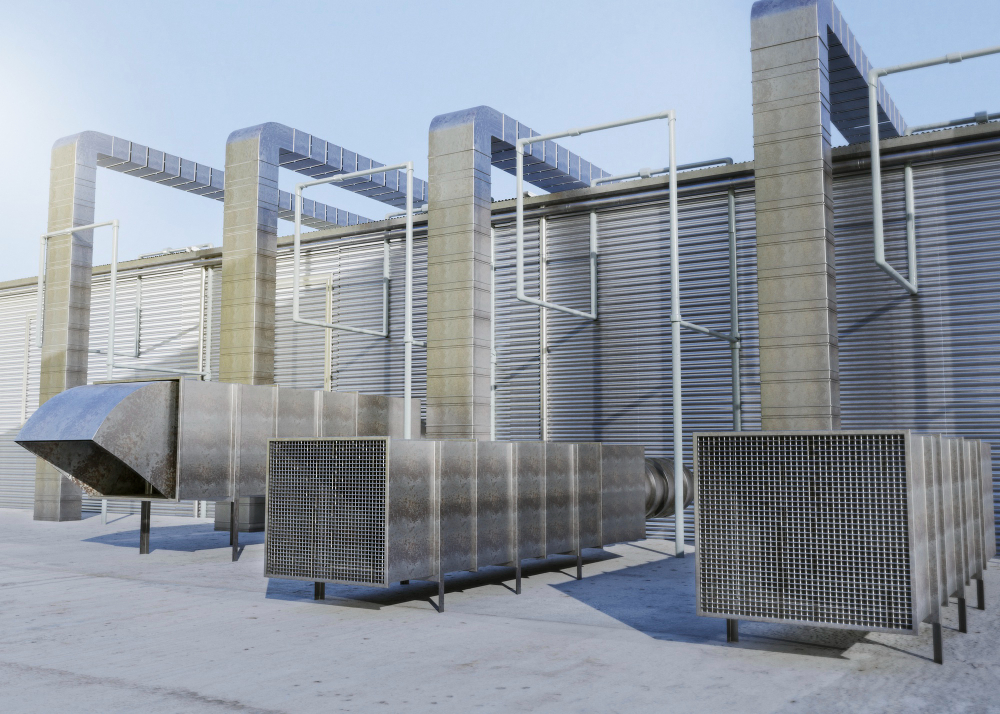
This is where the two-stage approach makes the difference. The Dutch manufacturer Oxycom builds systems that cool in two steps. The first stage pre-cools incoming fresh air indirectly, using cold water in a heat exchanger, without any evaporation into that air stream. Only in the second stage does direct evaporation take place. The result is supply air that is colder than a single-stage system can deliver, with up to 70% less added moisture. For humidity-sensitive production environments, that difference can determine whether evaporative cooling is viable at all.
Two-stage systems like this can save up to 90% in energy compared to traditional air conditioning. For a facility that struggles through every summer, that changes the business case, because cooling the whole hall becomes affordable instead of a luxury.
Where to Start in Your Own Facility
A good first step is mapping your actual heat load:
- Which equipment produces the most heat
- How much solar gain comes through the roof
- Where employees experience the worst conditions
With that picture in hand, you can have a supplier calculate whether evaporative cooling covers your situation and whether a direct or two-stage system fits your humidity requirements. In many large halls, the outcome is a cooling solution that costs less to run than the air conditioning you were hesitant to install.