Technology is constantly driving manufacturing forward – helping to achieve faster production speeds, increased accuracy, improved reliability and even reduced manufacturing costs. In this post, we’ll discuss five of the technologies that are making the biggest impact in manufacturing right now: IoT technology, artificial intelligence, 3D printing, digital twin technology and fiber laser cutting.
IoT technology
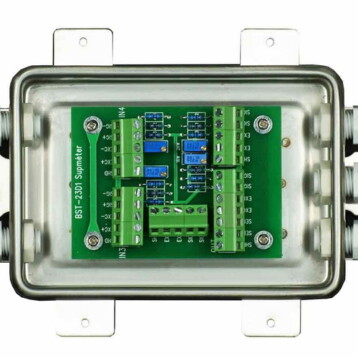
Internet of Things (IoT) technology involves connecting various equipment to the internet in order to be remotely controlled and monitored. In years gone by, manufacturing machinery would have to be manually operated and manually inspected. Sensors can now be fitted to machinery that can connect to computers, tablets or smartphones to provide analytic data on an app. This allows faults to be flagged up early before machines fail completely, while also allowing monitoring of emissions or temperature. It’s even possible to start up, reprogram and shut down machinery remotely using this technology.
Artificial intelligence
AI is now being used to carry out automated inspections of machinery, sending out alerts when things aren’t right and detecting problems without the need for human monitoring. AI is also being used to manage supply chains, helping to predict demand and preventing overstocking or shortages of materials. On top of this, AI is also being used to train robots. No longer are factory robots being designed to carry out single repetitive tasks, but instead complex tasks with changing input – this allows assembly lines to easily adjust to different batches, designs and materials for more personalized orders. Experiments with fully autonomous ‘lights out’ factories have also been trialled.
3D printing
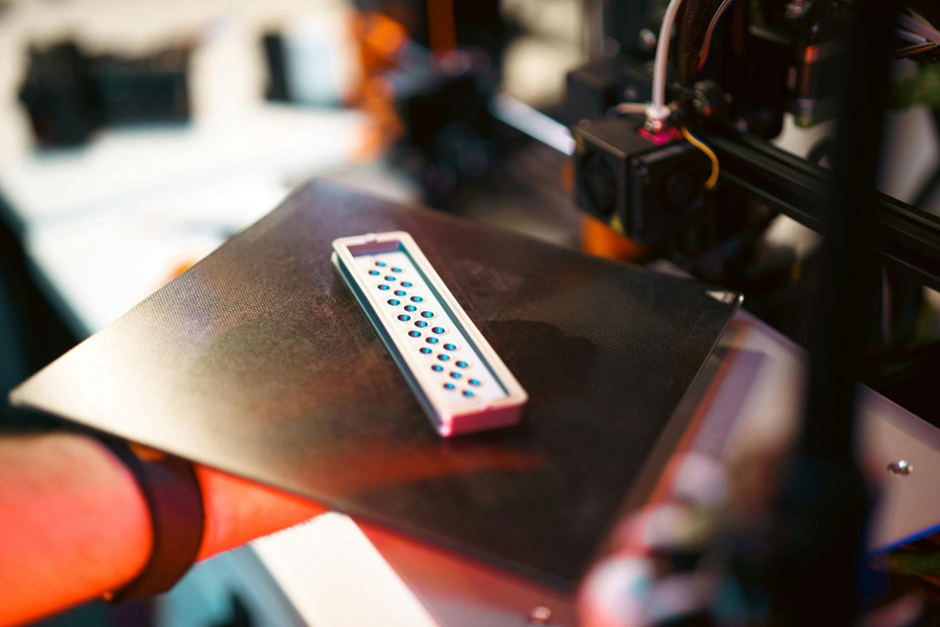
3D printing innovations are also transforming manufacturing. Using 3D printers, it’s now possible to quickly produce prototypes, while also being able to mass-produce complex items that are intricately shaped. Multi-color and multi-material printing is now possible too, helping to open up new doors for creativity in terms of designs. To reduce disposable plastic waste, 3D printers are now also being engineered to handle recyclable and sustainable materials. Combined with AI, 3D printers can also be trained to detect faults and also maintain themselves.
Digital twin technology
Digital twin technology has many applications within manufacturing from testing products to testing factory layouts. It involves creating a digital replica of a physical product or machine that can be analyzed in real time with software. Digital twins effectively act as a living blueprint. They can also serve as virtual prototypes that may be possible to digitally test in different challenging environments, rather than having to produce hundreds of physical prototypes.
Fiber laser cutting
Fiber laser cutting is the latest advancement in laser cutting technology. Compared to CO2 lasers and plasma, fiber lasers are able to provide much more precision and speed, while also being more energy efficient to run. Fiber laser cutters have been found to be particularly successful when using reflective materials like copper and aluminium (with a CO2 laser, the light can sometimes bounce back and destroy components). Factories that rely heavily on laser cutting are strongly advised to upgrade to this form of laser in 2026.