

Protective gear has changed enormously since the bulky vests of the 1970s. The goal now is armor you barely notice until the moment it matters.
Modern fibers can stop common handgun rounds while weighing under a pound per square foot. That weight saving is widening who chooses to wear protection and how often they keep it on.
Anyone curious about how far concealable vests have come can compare current designs here. What makes this moment different is the speed of progress in materials science.
Key Takeaways
• Aramid fibers such as Kevlar still anchor most soft armor, valued for strength and affordability.
• UHMWPE fibers like Dyneema trim weight while keeping the same protection.
• Graphene, liquid armor, and smart fabrics point toward thinner, sensor equipped vests.
• NIJ ratings remain the trusted benchmark for confirming real ballistic protection.
From Kevlar to Composite Fibers
The modern era of body armor started with Kevlar, the para-ramid fiber DuPont introduced in 1971 after chemist Stephanie Kwolek discovered it. Measured by weight, this material is roughly five times stronger than steel.
Soft armor behaves like a tight net. The woven strands catch a bullet, stretch, and spread its energy outward until the round halts.
A second leap arrived with ultra high molecular weight polyethylene, marketed under names like Dyneema. Its superior strength to weight ratio lets vests shed bulk while holding their coverage, a quality now central to modern wearable tech.
Watch: How Does Kevlar Armor Work? A short visual explainer of how woven fibers absorb a bullet’s energy. Embed this video here: https://www.youtube.com/watch?v=0Xz08DwqbHw
The Materials Driving the Next Generation
Graphene and Nanocomposites
Graphene is a sheet of carbon a single atom thick, yet laboratory tests rate it near 200 times the strength of steel for its weight. Peer reviewed research shows the material can absorb and disperse impact energy faster than aramid threads.
Blended with ceramics or polymers, these nanocomposites could eventually defeat rifle rounds at a fraction of present weight. Many of these gains trace directly to advances in nanotechnology.
Liquid and Self Adapting Armor
Shear thickening fluid stays pliable when moved slowly, then snaps rigid the instant a projectile lands. Layered between Kevlar sheets, it can slim down panels while softening blunt trauma.
Scientists at the University of Kent have pushed even further, building a protein based mesh from talin that absorbs shock and then springs back to shape. Substances that respond to force on their own hint at where protection is heading.
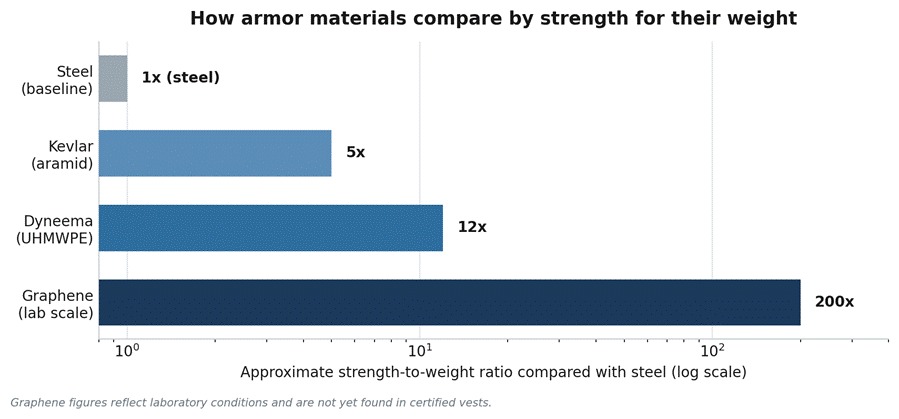
Approximate strength-to-weight ratios. Graphene values reflect laboratory results, not certified vests.
Soft Armor Versus Hard Armor
Selecting the right protection still depends on the threats you expect. Soft panels handle handguns and stay hidden, while rigid plates defeat rifle fire at the price of added bulk.
| Feature | Soft Armor | Hard Armor |
| Threats stopped | Handguns, strikes, slashes | Rifle rounds, armor piercing |
| Common materials | Kevlar, Dyneema (UHMWPE) | Ceramic, polyethylene, steel |
| Typical NIJ levels | IIA, II, IIIA | III, IV |
| Weight | Light, under about 1 lb per sq ft | Heavy, plates of several pounds each |
| Concealability | High, worn under clothing | Low, worn in a carrier |
| Best suited for | Patrol officers, civilians | Tactical teams, soldiers |
Built to Disappear Into Everyday Life
The clearest change is comfort. Slimmer panels now slide under a shirt, which counts because every extra pound resting on the torso adds about seven pounds of strain on the knees.
That ease is carrying armor past police and military circles. Teachers, reporters, and private citizens increasingly weigh personal protection within their wider thinking on defense and security.
How Protection Is Tested
Ratings matter far more than marketing language. The National Institute of Justice has published body armor standards since the early 1970s, and its NIJ Standard 0101.07, released in 2023, refreshes the testing approach for current rifle threats and for armor shaped to fit women.
Accredited laboratories fire calibrated ammunition at every design before it earns a rating level. This vetting is what divides verified equipment from untested marketing promises.
Frequently Asked Questions
Is body armor legal for civilians to own?
Across most of the United States, adults without felony convictions may legally buy and wear body armor. A handful of areas add restrictions, so confirm your local and state rules before purchasing anything.
What separates Level IIIA from Level III?
Level IIIA soft armor stops the majority of handgun rounds, including the .44 Magnum. Level III hard plates are engineered to defeat rifle ammunition, which flexible vests on their own cannot reliably handle.
How long does a vest actually last?
Most ballistic panels carry a five year manufacturer rating. Heat, moisture, and constant flexing all shorten that window, so check your panels often and retire them once the warranty has lapsed.
Can a soft vest stop a knife?
Woven panels resist many slashing strikes but not every focused stab. For edged dangers, choose armor that is specifically rated for stab and spike protection alongside its bullet stopping coverage.
Will graphene vests arrive soon?
Graphene delivers striking results in the lab, though turning it into affordable, certified armor takes time. Expect steady blending into composites rather than a sudden swap for the fibers used today.
The Road Ahead
Body armor is tracking the wider arc of technology, growing lighter, smarter, and far easier to live with. Materials once confined to journals are inching toward everyday vests.
The coming decade should fuse trusted fibers with graphene, embedded sensors, and adaptive layers. Protection that vanishes into ordinary clothing has stopped being science fiction.
References
National Institute of Justice. Ballistic Resistance of Body Armor, NIJ Standard 0101.07. 2023. https://nij.ojp.gov/topics/equipment-and-technology/ballistic-resistance-body-armor-nij-standard-010107
National Library of Medicine (PMC). Advancement in Graphene-Based Materials for Armour Applications. 2021. https://www.ncbi.nlm.nih.gov/pmc/articles/PMC8151629/
ScienceDirect. Body Armour: New Materials, New Systems. 2019. https://www.sciencedirect.com/science/article/pii/S2214914718305932
Explain That Stuff. How Does Kevlar Work? 2023. https://www.explainthatstuff.com/kevlar.html
Fact Check: All statistics and data points in this article were verified against original sources as of June 2026. Sources are listed in the References section.