Restaurant menu prices were up 3.4% year over year as of June 2026 — the slowest annual pace in seventeen months, according to National Restaurant Association data drawn from the Bureau of Labor Statistics, with full-service restaurants running a bit hotter at 3.7% and limited-service at 3.1%. Even slowing down, that’s still a line moving roughly every month. The menu itself — the printed object a guest actually reads — moves on a much slower clock: most operators are advised to touch it once or twice a year. Those two numbers describe the same business and don’t quite agree with each other, and the gap between them is where this gets interesting.
The Cadence Operators Are Actually Told to Follow
The standard guidance is consistent across the industry: a full menu refresh once or twice a year, with smaller seasonal or monthly rotations layered on top for specials. Quick-service operators are pushed to move faster — a new item at minimum every season, sometimes monthly, to keep pace with limited-time-offer culture. Reasons cited for the faster cadence tend to repeat across sources: seasonal ingredient availability, cost fluctuation that outpaces the printed price, and the slow accumulation of underperforming items that quietly drag down a menu’s overall margin until someone finally removes them. Recommendations on seasonal menu changes and restaurant frequency generally converge on the same number regardless of source: four rotations a year at minimum for anything genuinely ingredient-driven, more often for a concept built entirely around what’s currently available.
On pricing specifically, the advice gets more granular: recost the top twenty items by sales volume every month, but only formally adjust prices on the menu itself once or twice a year, and even then, touch 15 to 25 percent of listed items per pass rather than repricing the whole board at once. Planning windows of three to four weeks are recommended before a change goes live, so the shift doesn’t land on regulars all at once. A common intermediate step is testing a change as a limited-time special first — watching what happens to orders and margin before making it permanent, rather than committing a price or an item to the full menu untested. Guidance on restaurant menu changes that increase sales agrees on one point regardless of source: test first, roll out second. Menu changes that increase restaurant sales are rarely the ones nobody checked first.
None of this is arbitrary caution. A meaningful share of a restaurant’s revenue comes from a short list of dishes regulars order every single visit — Olo’s guest data puts repeat customers at roughly 60 percent of restaurant revenue — and that list is exactly what operators are told not to touch carelessly. The recommended discipline — small, staged, infrequent changes — is built to protect that list, not to avoid work for its own sake.
Restaurant chain menu changes behave differently at scale than at a single location. At a large, well-known chain, a change usually goes through weeks of regional testing before it reaches every location at once — reversing a decision system-wide costs far more than reversing it at one restaurant, which is why a famed restaurant chain’s menu changes tend to move slower and more cautiously than an independent’s, not faster. At the opposite extreme sits the occasional restaurant that changes menu every day by design — a market-driven kitchen built around whatever the morning delivery contained. Both are legitimate operating models; most restaurants land somewhere in the ordinary middle.
It Isn’t The Math That Stops Them
Restaurants that hesitate to update prices more than once or twice a year usually aren’t avoiding the math — they’re avoiding the reprint cost and the lead time that comes with a printed menu. Digital menu boards skip both: deckerapp.com/digital-menu-boards/. The price change cycle drops from days to minutes once pricing comes straight from the POS instead of a print shop, and the recosting that already happens monthly with no friction finally reaches the guest on the same schedule, instead of getting rationed down to once or twice a year by everything print production adds on top of it.
The Part The “15 to 25 Percent” Guidance Quietly Reveals
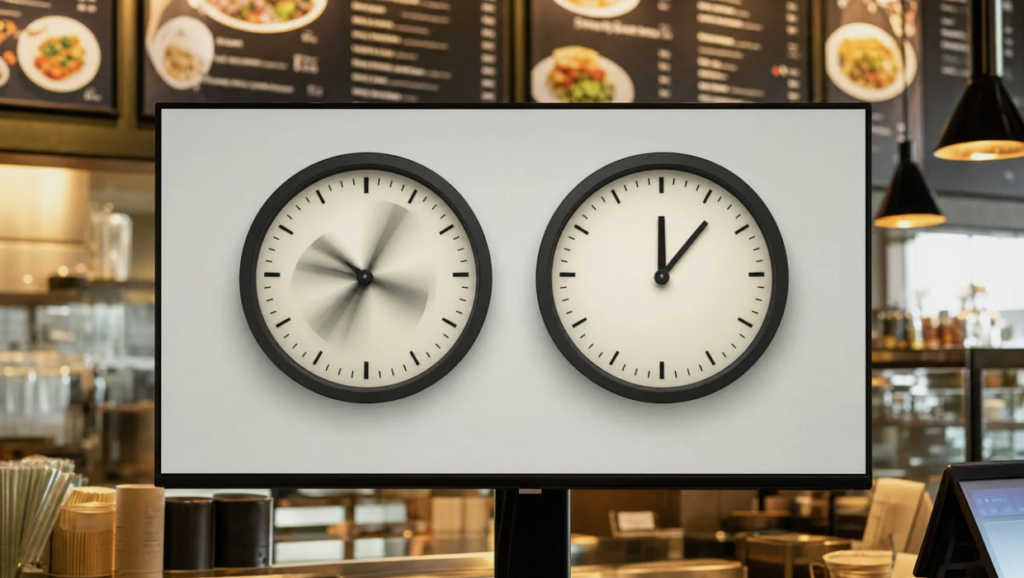
Here’s the detail worth sitting with. The standard advice already assumes partial updates — a fraction of the menu, not the whole thing, on any given pass. That’s sound guidance for a kitchen and a marketing plan. It’s much harder advice to follow for a printed object, where “update 20 percent of the items” still means designing, proofing, and reprinting the entire physical menu, because there’s no such thing as reprinting one line. The staged, careful approach the industry recommends and the all-or-nothing mechanics of a printed board are pulling in opposite directions, and the once-or-twice-a-year default is largely what happens when the second constraint wins.
What Changes Once The Constraint is Removed?
Take the printing step out — menu content pulled directly from POS data instead of a design file — and the 15-to-25-percent guidance stops being aspirational. A price on three items can change on a Tuesday without touching the other 80 percent of the board, without a design pass, without a proof, without a reprint lead time measured in days. The monthly recost and the once-or-twice-a-year published menu can finally run on the same schedule, instead of one waiting on the other.
The three-to-four-week planning window doesn’t disappear in that version — deciding what to change and why still takes as long as it takes. What disappears is the second, unrelated clock that used to run alongside it: the one counting down design, proofing, and print production before the decision could actually reach a guest. Collapsing those two timelines into one is most of the practical difference between a menu that updates once or twice a year and one that updates whenever the recost actually calls for it.
What this gets called varies by who’s describing it — digital menu boards, digital menu software, digital menu displays, digital menu signs, or just a digital board menu — but the mechanism underneath is the same: menu boards fed by a POS feed instead of a print shop are effectively immune to the reprint-cost math above, whether that’s digital menu software for tv running on a repurposed screen or a purpose-built digital menu display installed from day one. Digital menu boards for restaurants specifically tend to bundle POS integration as standard, not an add-on — the point of skipping print is skipping it consistently, not just on the days someone remembers to export a new file.
Three Numbers That Matter
- 3.4% — year-over-year menu price inflation as of June 2026, the slowest pace in seventeen months but still a line that moves roughly every month.
- 1–2 — the number of full menu updates most restaurants are advised to run per year, largely dictated by reprint cost and lead time rather than how often prices actually need to move.
- 15–25% — the share of items recommended per partial update, a staging strategy built for a kitchen and a marketing calendar, not for a medium that only knows how to publish everything at once.