Conversational 3D lets users generate and revise 3D assets through ongoing natural-language and visual instructions, while direct editing and human review remain necessary for production use.
Most digital creative tools still expect people to learn the language of the software before they can express an idea. In 3D modeling, that language includes viewports, modifiers, topology, UV maps, materials, rigs, export settings, and countless commands distributed across menus and keyboard shortcuts.
These systems give experienced artists precise control, but they also create a substantial entry barrier. Someone may be able to describe an object clearly, sketch it from several angles, or explain how it should function while having no idea how to construct it in conventional 3D software.
Generative AI has begun to change that relationship. Text-to-3D and image-to-3D tools made it possible to produce an initial model from a written description or reference image. The next shift is more ambitious: replacing a sequence of isolated commands with an ongoing conversation.
If that approach develops successfully, the future of 3D creation may depend less on knowing where every tool is located and more on being able to explain, evaluate, and refine an idea.
What Is Conversational 3D Creation?
Traditional interfaces ask the user to translate an intention into operations.
A designer who wants a wider base, a softer silhouette, and fewer surface details must know which vertices to move, which modifier to apply, and how to avoid damaging the rest of the geometry. The software understands actions, not reasons.
A conversational interface attempts to work at a higher level. The user describes the intended result: “Make the base more stable,” “reduce the ornament around the handle,” or “give the object a simpler low-poly style.” An AI system then interprets those instructions and connects them with suitable operations.
This does not eliminate the need for technical control. It changes where the interaction begins.
Instead of opening with an empty viewport, a creator can begin with a description, sketch, or reference photograph. A usable concept may appear early enough to support discussion and testing before someone invests hours constructing it manually.
Platforms such as Meshy AI illustrate this broader move toward generating 3D content from text and images. The important development is not simply that a model appears more quickly. It is that people who think visually or verbally can enter the process without first mastering every part of a professional modeling application.
Why Conversation Changes Iteration
A single prompt can generate an interesting result, but creative work rarely follows a single-prompt path.
The first version may have the right general character but the wrong proportions. A chair might look elegant while appearing uncomfortable to sit in. A game prop might have a strong front view but an incoherent back. A creature may have the desired silhouette but far too many small details for the intended visual style.
With a one-shot generator, the user often has to rewrite the prompt and begin again. Each new result may solve one problem while introducing several others.
A conversational system can potentially preserve more context, depending on the platform. A revision may regenerate parts—or all—of the model rather than apply a deterministic local edit. The user can select a direction and request targeted changes rather than repeatedly returning to the beginning. This makes the interaction closer to a design review:
- Keep the overall body, but shorten the legs.
- Retain the material palette and simplify the surface pattern.
- Make the handle thicker without changing the main silhouette.
- Show a cleaner version suitable for viewing at a distance.
A conversational system may retain accepted design decisions, but users should verify which geometry, materials, and proportions were actually preserved.
The advantage is not just speed. It is continuity. A productive creative process depends on remembering which decisions have already been accepted and which parts remain uncertain.
That continuity also makes comparison more useful. Several variations can be judged against the same brief rather than appearing as unrelated outputs. The creator can focus on choosing among directions instead of reconstructing the entire request for every attempt.
A Broader Entry Point for 3D Creation
Conversational 3D could be particularly useful for people whose work involves 3D ideas but who are not full-time 3D artists.
An independent game developer may need rough props to test scale and interaction. A teacher may want a simple model to explain a historical object or scientific structure. A product team may need several forms for an early presentation. A maker may want to evaluate the proportions of a printable concept before rebuilding it more precisely.
In these situations, the first objective is often not a perfect final asset. It is an object that makes an idea visible enough to discuss.
This distinction matters. Conventional 3D production remains essential when a project requires exact dimensions, controlled topology, consistent deformation, detailed material work, engineering tolerances, or a tightly managed visual style. However, not every early decision needs that level of investment.
A conversational tool can create a lower-cost space for asking preliminary questions. Is the object too tall? Does the silhouette communicate its purpose? Would a wider body feel more stable? Does the design belong with the rest of the scene?
Finding a weak direction early is valuable, even if the model itself is later replaced.
AI 3D Agent vs. 3D Generator: What Is the Difference?
The term “AI agent” is often applied loosely. In a useful 3D context, it should mean more than placing a chat box beside a generator.
An agent should be able to maintain the design brief, offer alternatives, accept text or visual references, and help move a chosen concept toward an exportable model. It should also explain relevant 3D concepts when the user encounters a decision they do not understand.
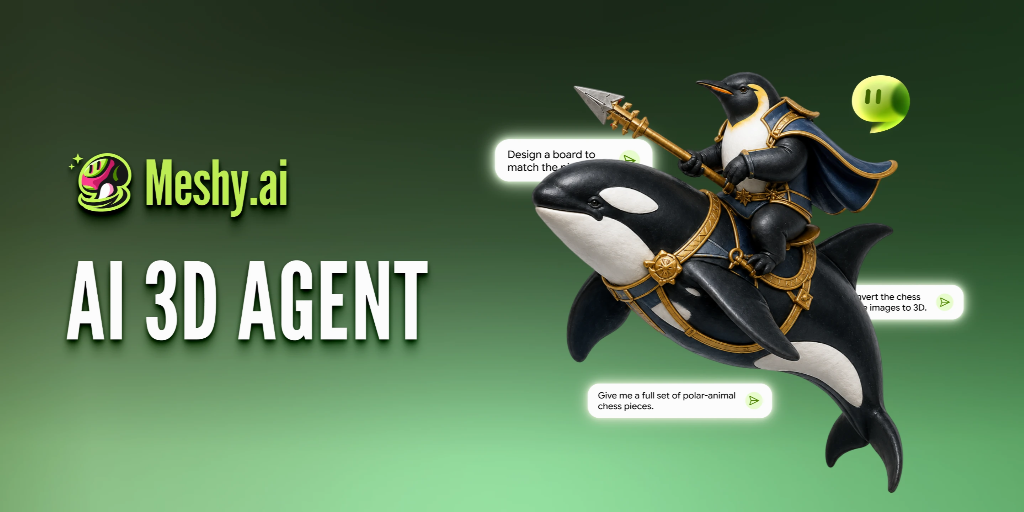
The Meshy 3D Agent, currently presented as a beta feature, provides one example of this direction. Its workflow uses conversation to brainstorm ideas, generate visual options, select a concept, convert it into 3D, and prepare it for export.
This integrated structure is significant because creative friction often occurs between stages. A promising sketch may never become a model because the next tool requires different knowledge. A generated model may remain unused because the creator does not understand formats, geometry, or the requirements of the destination software.
An agent can help connect those stages, but connection should not be confused with guaranteed readiness. Exporting a file is not the same as proving that it is suitable for every downstream use.
What Are the Limits of Conversational 3D?
Natural language is accessible, but it is not always precise.
“Make it more futuristic” can describe hundreds of incompatible visual choices. “Add more detail” does not explain where the detail belongs, what scale it should have, or whether it should be structural or decorative. Even a simple instruction such as “make the object smaller” is ambiguous unless the system knows whether the user means overall dimensions, visual mass, or file size.
Spatial relationships are particularly difficult to communicate without visual feedback. A user may describe the front of an object accurately while forgetting the rear, underside, joints, or internal structure. An AI system must infer missing information, and those inferences may not match the intended design.
Better conversations will therefore depend on more than better prompts. They will require visual selection, annotations, regional editing, multiple views, measurements, and clear ways to approve or reverse changes.
The most useful interface may combine language with direct manipulation. A creator might circle one part of the model, drag a proportion, lock an approved section, and then describe what should happen next. Conversation becomes one control method among several rather than the only one.
Generation Does Not Remove Technical Review
A model can look persuasive in a rendered preview while containing problems that become obvious later.
For a game asset, the polygon distribution may be unsuitable, UVs may need revision, materials may be unnecessarily complex, and collision geometry or levels of detail may still be missing. A character may require topology that bends predictably during animation.
For 3D printing, the designer must check wall thickness, closed geometry, unsupported areas, balance, clearances, part orientation, and the limitations of the chosen printer and material. Passing through a slicer does not guarantee that an object will print reliably or function as intended.
Product visualization creates another set of questions. A generated form may be useful for communicating appearance while being unsuitable for manufacturing, safety evaluation, or engineering decisions.
Human review remains necessary because quality depends on context. The same mesh can be acceptable as a distant background object, unsuitable as an animated hero asset, and dangerous as the basis for a functional component.
Conversational AI can reduce the work required to reach the review stage. It cannot decide what level of risk or accuracy a particular project can tolerate.
How Creative Skills May Change
If conversational 3D becomes common, creative expertise will not disappear. Some of it will move.
Knowing how to operate complex software will remain valuable, especially for correction and high-end production. At the same time, other abilities will become more important: writing a clear design brief, identifying weak geometry, comparing variations, maintaining visual consistency, and knowing when an automated result should be rejected.
This resembles the difference between producing an image and directing a visual project. Generating options is useful, but someone still has to decide what the object is for, which version supports that purpose, and what must change before it can be used.
Professional 3D artists may also spend less time building every early variation and more time defining systems, supervising outputs, solving difficult forms, and preparing selected assets for their final environments.
For beginners, conversational tools may provide an entry point. For experts, they may become an additional layer of automation. The same interface will not remove the difference between those skill levels, because experts will still recognize problems that new users cannot yet see.
Will Conversational AI Replace Traditional 3D Software?
No. It is more likely to become an additional interaction layer on top of existing viewport-based, CAD, and professional editing tools rather than a replacement.
The next generation of 3D software is unlikely to abandon viewports, timelines, node systems, sculpting tools, and precise numerical controls. Those interfaces exist because spatial work often requires direct and exact manipulation.
Conversation is more likely to sit above them.
A user may begin with a sentence, explore several concepts, choose one, and request broad changes through dialogue. The model can then move into more specialized tools for topology, rigging, simulation, engineering, animation, or fabrication. Corrections made in those environments may eventually be understood by the agent and carried into future iterations.
The real promise of conversational 3D is therefore not a world in which nobody needs technical knowledge. It is a world in which an idea can enter the 3D process earlier, more people can participate in its development, and specialists can focus their attention where precision matters most.
The interface changes from “learn every command before you begin” to “show the idea, discuss it, test it, and improve it.” That is a meaningful shift—but the conversation still needs an informed human on the other side.