
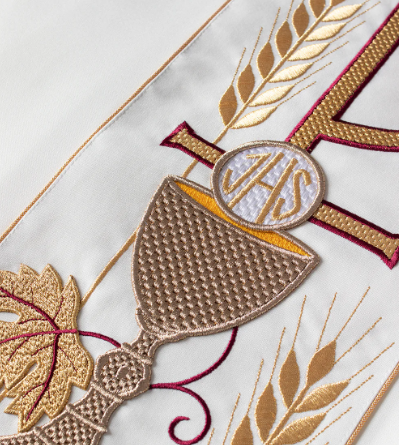
In the heart of Catholic tradition, liturgical vestments play a role of primary importance, not only for their practical function, but also for the profound symbolic meaning they embody. Among the most precious and sought-after fabrics for the making of these sacred vestments, silk occupies a place of honor. Silk liturgical vestments, with their unparalleled elegance and the luxury they exude, represent an homage to the sacredness of the rite and the dignity of the celebrant. In this article, we will explore the reasons why silk is so appreciated in the creation of sacred vestments, its unique characteristics, and how to choose the perfect silk liturgical vestment for every occasion.
Why Choose Silk for Liturgical Vestments?
The choice of silk for liturgical vestments is not accidental, but dictated by a series of factors that enhance its qualities and make it particularly suitable for this purpose. Silk, in fact, possesses unique characteristics that distinguish it from other fabrics:
- Luminosity and brilliance: Silk is able to reflect light in a natural way, giving the vestment a luminous and brilliant appearance, which enhances the sacredness of the moment.
- Softness and fluidity: Silk is an extremely soft and fluid fabric, which envelops the body with elegance and comfort, ensuring the celebrant the utmost freedom of movement.
- Resistance and durability: Despite its apparent delicacy, silk is a strong and durable fabric, able to withstand the wear of time and maintain its beauty intact.
- Hypoallergenic properties: Silk is a natural and hypoallergenic fabric, suitable even for the most sensitive skin.
- Prestige and symbolic value: Silk has always been associated with luxury and elegance, and its use in the making of liturgical vestments gives them an even greater symbolic value.
Types of Silk Liturgical Vestments
Silk is used for the making of a wide range of liturgical vestments, each with its specific characteristics and symbolic meaning. Among the most common, we find:
- Chasuble: The chasuble is the most important liturgical vestment, worn by the priest during the celebration of Mass. Made of precious silk, the chasuble is often decorated with embroideries and applications that enhance its beauty and sacredness.
- Stole: The stole is a strip of fabric that the priest wears around the neck, a symbol of his priestly ministry. The silk stole is an elegant and refined accessory, which completes the liturgical vestment.
- Cope: The cope is a large mantle worn by the priest over the chasuble, a symbol of the charity that must envelop his ministry. The silk cope is a solemn and majestic vestment, suitable for the most important celebrations.
- Dalmatic: The dalmatic is the liturgical vestment proper to the deacon, a symbol of his service to the Church. The silk dalmatic is an elegant and functional vestment, which allows the deacon to perform his ministry with dignity and decorum.
- Humeral veils: Humeral veils are used during Eucharistic blessings and processions. Made of silk, often embroidered with gold threads, they add a touch of solemnity and respect to the sacrament.
How to Choose the Perfect Silk Liturgical Vestment
Choosing the perfect silk liturgical vestment is a delicate process that requires attention and care. It is important to consider several factors, including:
- The type of celebration: The choice of liturgical vestment must be appropriate to the type of celebration. For the most solemn celebrations, such as Christmas or Easter Mass, it is advisable to opt for richly decorated silk vestments. For ordinary celebrations, on the other hand, you can choose simpler and more essential silk vestments.
- The liturgical color: The color of the liturgical vestment must comply with the liturgical calendar. Each color has a specific symbolic meaning and is used in certain periods of the year.
- The style: The style of the liturgical vestment must be in harmony with the personal taste of the celebrant and with the style of the church. You can choose from classic and traditional silk vestments, or more modern and innovative silk vestments.
- The quality of the fabric: It is essential to choose liturgical vestments made of high-quality silk, to ensure their durability and beauty over time.
- The fit: The liturgical vestment must be comfortable and well-fitting, to allow the celebrant to move freely and perform his ministry with agility.
The Importance of Details: Embroidery and Finishes
Silk liturgical vestments are often embellished with embroideries and finishes that enhance their beauty and sacredness. The embroideries can be made by hand or by machine, and can represent religious symbols, sacred figures, or ornamental motifs. The finishes, on the other hand, can be made with trimmings, fringes, braids, or other decorative elements. The choice of embroideries and finishes must be accurate and in harmony with the style of the liturgical vestment.
Caring for Silk Liturgical Vestments
Silk liturgical vestments are delicate garments that require special care to keep them in perfect condition over time. It is advisable to:
- Dry clean the vestments: Dry cleaning is the safest method for cleaning silk liturgical vestments, as it avoids the risk of shrinkage or damage to the fabric.
- Iron the vestments at a low temperature: Silk is a delicate fabric that irons easily. It is important to iron the vestments at a low temperature, using a protective cloth to avoid damaging the fabric.
- Store the vestments in a cool, dry place: Silk liturgical vestments should be stored in a cool, dry place, away from direct sunlight and humidity. It is advisable to use special covers to protect them from dust and insects.
HaftinaUSA.com: Your Partner for Silk Liturgical Vestments
If you are looking for high-quality silk liturgical vestments, made with care and attention to detail, HaftinaUSA.com is your ideal partner. We offer a wide range of silk liturgical vestments, for all occasions and for all tastes. In our catalog, you will find chasubles, stoles, copes, dalmatics, and other sacred vestments, made with precious fabrics and finished with craftsmanship. Visit our site and discover our collection of silk liturgical vestments. We will be happy to help you choose the perfect vestment for you.
Silk and Liturgy: A Combination of Beauty and Spirituality
Silk liturgical vestments represent a perfect combination of beauty and spirituality. Silk, with its elegance and luxury, enhances the sacredness of the rite and the dignity of the celebrant. Choosing a silk liturgical vestment means investing in a high-quality garment, destined to last over time and to witness the faith and devotion of the wearer. Rely on HaftinaUSA.com to find the silk liturgical vestment that’s right for you, and experience the liturgy with even more intensity and beauty.
The Evolution of Silk Liturgical Vestments Over Time
The history of silk liturgical vestments is rich and fascinating, a testimony to an evolution that has spanned centuries. Since the early days of Christianity, silk has been appreciated for its beauty and value, and used for the making of sacred vestments intended for celebrants. Over time, silk liturgical vestments have undergone stylistic and decorative transformations, adapting to changes in taste and the needs of the liturgy. However, silk has always remained a privileged fabric, a symbol of elegance and sacredness.
The Meaning of Colors in Silk Liturgical Vestments
The colors of liturgical vestments are of fundamental importance, as they express specific symbolic meanings and are linked to the liturgical calendar. Each color is associated with a particular period of the year or a specific celebration. For example, white is the color of joy and purity, used during the Easter and Christmas seasons. Red is the color of blood and martyrdom, used during Holy Week and in the feasts of the martyrs. Green is the color of hope and life, used during Ordinary Time. Violet is the color of penance and preparation, used during Advent and Lent. The choice of the color of the silk liturgical vestment must therefore be accurate and in accordance with the liturgical calendar.
The Importance of Craftsmanship in the Creation of Silk Liturgical Vestments
The creation of silk liturgical vestments is an art that requires mastery, passion, and attention to detail. The artisans who dedicate themselves to this activity are custodians of ancient knowledge, passed down from generation to generation. Each silk liturgical vestment is a unique piece, made with care and dedication, which testifies to the beauty and sacredness of the liturgy. Supporting craftsmanship in the creation of silk liturgical vestments means valuing a precious cultural heritage and helping to preserve an ancient and noble art.
Silk and Sustainability: A Commitment to the Future
Today, sustainability is an increasingly important issue, even in the textile sector. The production of silk can have a significant environmental impact if not managed responsibly. For this reason, it is important to choose silk liturgical vestments made with sustainable methods that respect the environment and the rights of workers. Some companies, such as HaftinaUSA.com, are committed to using silk from certified sources and reducing the environmental impact of their production. Choosing sustainable silk liturgical vestments means making a conscious choice that helps protect our planet and ensure a better future for future generations.
Tips for Matching Silk Liturgical Vestments
Matching silk liturgical vestments correctly is essential to create a harmonious and respectful image of the liturgy. Here are some useful tips:
- Consider the liturgical color: Ensure that the color of the main vestment (chasuble, cope) conforms to the liturgical season.
- Match the stole: The stole should be the same color as the main vestment or a complementary color. Make sure the style of the stole matches the vestment.
- Choose coordinated vestments: If using other vestments, such as the humeral veil, ensure they are of the same style and color as the other vestments.
- Consider the style of the church: The style of the vestments should be in harmony with the architectural and decorative style of the church.
- Maintain simplicity: Avoid overloading the image with too many details or contrasting colors. Simplicity is often synonymous with elegance.
Conclusion
Silk liturgical vestments continue to be a prestigious choice for those who wish to honor the liturgy with elegance and luxury. Their intrinsic beauty, combined with the symbolic meaning of the colors and decorations, makes them an essential element in religious celebrations. Choosing silk liturgical vestments carefully, considering the quality of the fabric, the style, and the craftsmanship, is an investment that enhances the sacredness of the rite and the dignity of the celebrant. HaftinaUSA.com offers an exclusive selection of silk liturgical vestments, designed to meet the needs of every parish and priest, always ensuring the highest quality and attention to detail. Visit our site to discover the complete collection and be inspired by the beauty and spirituality of silk liturgical vestments. Chasubles Haftina USA





![10 Best Place to Find OnlyFans Leaks [Free & Working]](https://thefutureofthings.com/wp-content/uploads/2025/11/OnlyFans-358x358.png)


