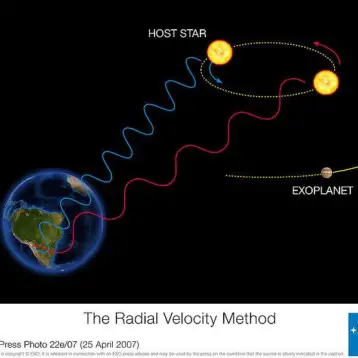
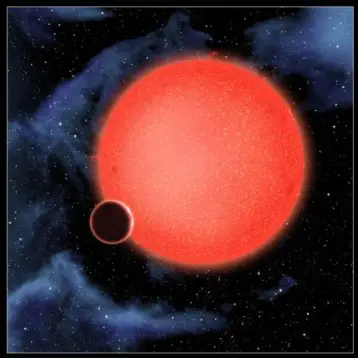
In 2005, scientists discovered a gas giant named HD 189733b, 63 light-years away from Earth in the constellation Vulpecula. The planet was discovered using a method called transit. A transit is the astronomical event that occurs when one celestial body appears to move across the face of another celestial body. Since extrasolar planets are too dim to be observed directly, astronomers often use the dimming light of the parent star as the planet passes between it and the Earth in order to verify the existence of the planet.
In the case of HD 189733b, a team of astronomers lead by Giovanna Tinetti, European Space Agency (ESA) fellow at the Institute d’Astrophysique de Paris, were able to detect a three percent change in the brightness of the parent star when the planet orbited around it. Using Spitzer, Tinetti and the team observed the starlight dim at two infrared bands (3.6 and 5.8 micrometers).
Had the planet been a rocky body devoid of atmosphere, both these bands and a third one (8 micrometres), recently measured by a team at Harvard, would have shown the same behavior. Instead, as the planet’s tenuous outer atmosphere moved across the face of the star, there was a different, distinctive pattern in the starlight absorbed by Spitzer. The atmosphere absorbed less infrared radiation at 3.6 micrometers than at the two other wavelengths. According to the team, only water vapor molecules can explain this behavior.
However, the existence of water molecules in the star’s atmosphere doesn’t necessarily make HD 189733b a good candidate for harboring human life. HD 189733b is huge, about 1.15 times the mass of Jupiter, orbiting its star in an average distance of 4.5 million kilometers (almost 20 times closer than Mercury is to our own Sun). This proximity causes the planet to reach scorching temperatures of 700 degrees Celsius.
The Spitzer space telescope was recently used to discover another extrasolar “first”. As TFOT reported, the telescope was used by astronomers from University of California at Los Angeles to detect the first ever quadruple-star system which may also contain planets.
More information on HD 189733b and the recent discovery of water molecules in its atmosphere can be found on ESA’s website.