The Spitzer’s infrared spectrometer enabled astronomers to study the ‘dusty disk’ that revolves around a pair of stars in the quadruple-star system HD 98800 for the first time. Such ‘dusty disks’, formally called accretion discs, are composed of diffuse material that is set in orbital motion around a central body or bodies. These accretion discs are thought to be the birth place of planets. Using Spitzer, the astronomers detected gaps in the accretion disc which they interpret as either the result of a unique gravitational relationship between the system’s four stars or as a possible indication of planet formation close to the two suns.
Before the recent observation by Spitzer, astronomers had a rough idea of the system’s structure from observations with ground-based telescopes. They knew the system contains four stars, and that the stars are paired off into doublets, or binaries. The stars in each of the binary pairs orbit around each other and the two pairs also circle each other. Only one of the stellar pairs, called HD 98800B, has a disk of dust orbiting it.
The distance separating the two binary pairs is about 50 astronomical units (AU) – slightly more than the average distance between our Sun and Pluto. Until now, ground based telescopes were not able to examine the accretion disc around HD 98800B closely. Spitzer’s powerful infrared spectrometer was able to reveal the gaps in the disk for the first time. Spitzer’s “probing eye” was able to reveal the presence of two belts in the accretion disc made of large dust grains. One belt is located approximately 5.9 AU away from the central binary, HD 98800B (about the distance from the Sun to Jupiter) and is likely composed of asteroids or comets. The other belt is located much closer to the star at 1.5 to 2 AU, (about the distance of Mars from the Sun) and is thought to be consisted of fine grains.
Elise Furlan, of the NASA Astrobiology Institute at the University of California at Los Angeles was reported to say that “When astronomers see gaps like this in a debris disk, they suspect that a planet has cleared the path. However, given the presence of the diskless pair of stars sitting 50 AU away, the inward-migrating dust particles are likely subject to complex, time-varying forces, so at this point the existence of a planet is just speculation”. More research and observation will probably be needed before the quadruple-star mystery of HD 988000 will be resolved.
More information on the recent finding can be found on NASA’s website.
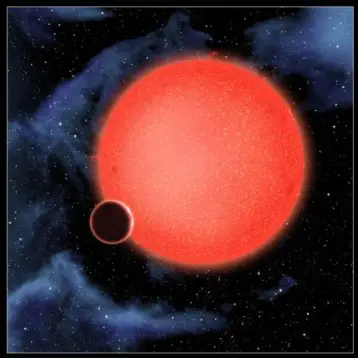
Image: Artist’s concept illustrates a quadruple-star system (credit: NASA/JPL-Caltech/UCLA).