Feedback Form
   
Add to Google
Measuring Ultra-short Laser Pulses Measuring Ultra-short Laser Pulses
Tuesday, June 03, 2008 - Roni Barr
Home >> News >> Physics
  Peralink
Researchers at the Georgia Institute of Technology have developed the first device to directly measure complex ultrashort light pulses in space and time at and near the focus of the pulses. Knowing how light is distorted allows researchers to correct for the aberrations by changing a lens or manipulating the pulse into the desired form. Since lasers that emit ultrashort pulses of light are used for numerous applications, including micromachining, microscopy, laser eye surgery, spectroscopy, and controlling chemical reactions, the new device may greatly contribute to advances in these fields.

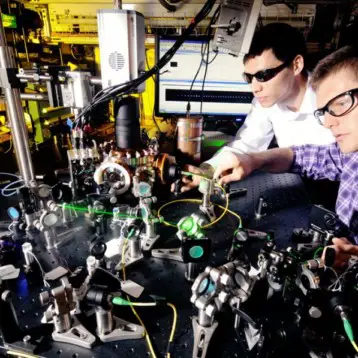
 Georgia Tech physics professor Rick Trebino and graduate student Pam Bowlan pose with SEA TADPOLE, a device that allows non-laser scientists to easily measure complicated ultrashort pulses. (Georgia Tech Photo: Gary Meek)
Georgia Tech physics professor
Rick Trebino and graduate student
Pam Bowlan pose with SEA TADPOLE,
a device that allows non-laser
scientists to easily measure complicated
ultrashort pulses.
(Credit: Georgia Tech / Gary Meek)
Until recently, the light pulse has always measured immediately as it exited the laser. Researchers did not realize the extent to which the light was distorted by the time it reached the focus point, after traveling through the optics and lenses in the system. 

Because the pulses typically last a few thousandths of a second and are faster than the response time of the fastest electronic devices, it was extremely difficult to measure them. The light, which comes out as a train of extremely short bursts, creates intense laser pulses. A new device, called the SEA TADPOLE (Spatial Encoded Arrangement for Temporal Analysis by Dispersing a Pair of Light E-fields), has been developed to allow researchers to measure ultrashort light pulses simultaneously in space and time as they go through the focus. 

The laser pulses enters the SEA TADPOLE through optical fibers, which only collect a very small portion of the light. Therefore, the device naturally measures pulses with high spatial resolution and can measure them at a focus spot that is smaller than a micron. Using specialized fibers the GIT researchers were able to further improve the spatial resolution of the device. The device was tested by measuring ultrashort pulses focused by various lenses, since each lens can cause different complex distortions. 

Since aberrations can drastically increase the pulse length, which in turn causes a decrease in intensity, the SEA TADPOLE system tells researchers what types of aberrations are present. Using this data, scientists can eliminate the affect of distortions by testing different lenses in the instrumentation or creating the desired pulse at the focus. 

TFOT recently covered the world's shortest single photon pulse containing just one photon, which was produced by Oxford University scientists. TFOT also reported on the research and development of the dual distributed Bragg reflector (DBR) grating semiconductor laser.

More information about the SEA TADPOLE can be found on the Georgia Institute of Technology website.


Related News Saser - The Sonic Laser Saser - The Sonic Laser Higgs Will Wait - LHC Temporarily Shut Down Higgs Will Wait - LHC Temporarily Shut Down

Related Pictures 2007 Nobel Prize in Physics 2007 Nobel Prize in Physics ATLAS Detector Finally Assembled ATLAS Detector Finally Assembled

Other Articles Fujitsu S300 Scanner Review Fujitsu S300 Scanner Review 2008 in Science, Medicine and Space 2008 in Science, Medicine and Space


No comments have been posted for this item.

Add a New Comment
Your name:   0/20
Subject:  0/30
Your Comment:  0/999
Type the following letters: Visual CAPTCHA
Please keep your comments related to the above item's topic. TFOT reserves the right to delete any unrelated comment without notice.

Picture Of The Day
Floating Jelly Hat
Floating Jelly Hat

Video
Paralysed Rats Sprint

Site Of The Week
Galaxy Zoo
Galaxy Zoo

Personal Column
Detroit’s Dream of Aircraft Production
Dr. Daniel Uziel
Detroit’s Dream of Aircraft Production
Terms Of Use | Privacy Policy | Contact Us | Advertise With Us | Site Profile
Copyright © 2007 The Future of Things. All rights reserved.