fbpx

Technology

Afghan Language Translation Devices for U.S. Army

Afghan Language Translation Devices for U.S. Army

Scientists from the National Institute of Standards and Technology have developed an innovative translation system for the U.S. Army, to be used in Afghanistan. Since many American soldiers don’t know the Afghan language, the new development could provide them an ...

Read more

Silver Nanoparticle for Creating Small Electronics

Researchers at the University of Illinois at Urbana-Champaign (UIUC) have developed a nanoparticle ink that could make flexible printed electronics and solar cell arrays much easier to generate. Composed of a water-based solution mixed with a high concentration of silver ...

Read more

New ‘Smart’ Nanocapsule Delivery System

New ‘Smart’ Nanocapsule Delivery System

Researchers at the UCLA Henry Samueli School of Engineering and Applied Science have recently developed a new intracellular delivery platform that uses nanocapsules. These tiny capsules are made up of a single-protein core and has a thin polymer shell; thanks ...

Read more

Low Temperature Fuel Cells

Low Temperature Fuel Cells

Researchers at Japan’s National Institute of Advanced Industrial Science and Technology have developed a new type of solid oxide cell made from common materials that operates at lower temperatures than standard solid oxide fuel cells. The tube shaped cell can ...

Read more

A Peek at the World’s Thinnest Material

A Peek at the World’s Thinnest Material

Researchers at Northwestern University have recently found an innovative method to see the world’s thinnest material, graphene. Using dye fluorescein – a known chemical, used in many fields and industries – the team introduced a new imaging technique to view ...

Read more

Overcoming Barriers for Organic Electronics

Overcoming Barriers for Organic Electronics

Researchers from Stanford University have recently shown that it is possible to create electronics basing on organic materials. This novel demonstration might help engineers to design better digital displays, ‘electronic newspapers’ and other futuristic devices that rely on such improvements ...

Read more

DARPA’s New High Resolution Camera

DARPA’s New High Resolution Camera

The Defense Advanced Research Projects Agency (DARPA) is developing a camera with unprecedented resolution, of 2.3-gigapixel. The new camera should be able to create super-wide aerial photos, and is built primarily for surveillance purposes, as part of the Autonomous Real-time ...

Read more

Nanolenses for High Resolution Imaging

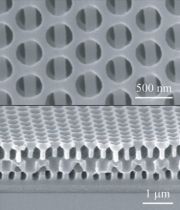
Researchers at the Pohang University of Science and Technology in Korea have developed nanolenses capable of imaging objects too small for conventional lenses. They can also be used for ultraviolet lithography and detecting infrared light emitted by quantum dots. The ...

Read more

R-1 Mouse-Like Analog Radio

R-1 Mouse-Like Analog Radio

An analog radio is one of the most important products for blind people. Ilgu Cha from the Royal College of Art in London is an award winning designer who has developed the R-1 analog radio, which can be operated by ...

Read more

Filling Fullerene with Radioactive Atoms

Filling Fullerene with Radioactive Atoms

Scientists from Virginia Commonwealth University (VCU) have developed a hands-off process for filling fullerenes with radioactive material. Fullerenes are hollow carbon molecules that can be filled with different types of metal atoms. This new finding could be utilized in medical ...

Read more