Engineers from Princeton University developed a new laser-sensing technology that may allow soldiers to detect hidden bombs from a distance as well as potential suicide bombers. The research team from Princeton’s Department of Mechanical and Aerospace Engineering that developed the ...
SMX-25 a Ship-Sub Hybrid
The French company DCNS developed an interesting concept ship which is essentially a stealth submarine which operate very close to the surface of the water. The SMX-25 will be cheaper and easier to build and operate than a conventional submarine ...
Eurocopter X3 – Fastest Helicopter on the Planet?
Last week a new European hybrid helicopter was able to reach an almost unprecedented speed of 232 kts. (or 430 km./hr.). This demonstration indicates one more time that the future of high speed helicopters will be based upon hybrid technology. ...
MIT Makes Sense of Advances in Technology
Not all technologies are being developed at the same rate. Computer micro chips advance much faster than many optical technologies for example. Researchers from MIT recently showed that it may be possible to predict which technologies are likeliest to advance ...
Israel Developing Flying Elephants
According to a soon to be published article in the defensenews magazine, Israel has started working on a project known as “Flying Elephants”. The futuristic unmanned aircraft is said to be huge and slow, capable of self takeoff and landing ...
Nikon Image Camera Authentication System Broken
Russian security experts were able to brake Nikon’s camera Image Authentication System. Credibility of photographic evidence is essential when images shot with a camera are used as court evidence or insurance claims and journalistic work. Russian President became addicted to ...
Scientist Develop Self Correcting Sniper Rifle
A team of scientists from the Oak Ridge National Laboratory developed a system which uses fiber-optic laser-based sensor that automatically corrects minute barrel disruptions and allows snipers to score bull’s-eye more easily. A laboratory prototype of Oak Ridge National Laboratory’s ...
Badges Detect Shock Waves
Scientists at the University of Pennsylvania School of Medicine in Philadelphia, Pennsylvania developed new badges that visibly react to exposure to shock waves by changing color. Developers can calibrate the badges to show the exposure level of the wearer, similar ...
Termite-Inspired Architecture
Researchers at the State University of New York College of Environmental Science and Forestry in Syracuse are studying the design of termite mounds in hopes of applying their principles to full scale architectural projects. The long term project yielded surprising ...
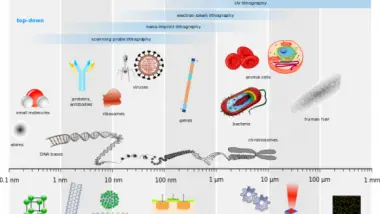
Nanoscale Transistors Probe Cells
Scientists from Harvard University recently introduced a unique method to probe interior cells. Their design consists of ultra-small wires and transistors, sensitive enough to respond to various biological changes, thus measuring biochemical elements. A new device, small enough to be ...