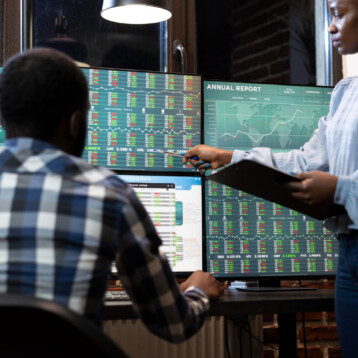
Algorithmic trading is no longer a niche practice reserved for institutions. As it grows into the default way retail traders operate, a trading VPS shifts from an optional upgrade to baseline infrastructure. Most Expert Advisor failures trace back to network and uptime problems, not the trading logic itself.
Grand View Research projects the global algorithmic trading market will grow from $21.06 billion in 2024 to $42.99 billion by 2030, a 12.9 percent annual growth rate. That trajectory is why the infrastructure question below is worth answering now, rather than after the market has already moved past it.
What Is Algorithmic Trading, and How Is It Changing Heading Into 2027?
Algorithmic trading is any strategy where pre-set rules, not a human clicking a mouse, decide when to enter and exit a position. That definition covers everything from a simple Expert Advisor on MetaTrader to a fully coded bot querying external data feeds.
Retail Adoption Is Accelerating
Retail traders have adopted this approach quickly. Coherent Market Insights projects retail investors will hold about 38.5 percent of the algorithmic trading market in 2026, up from single digits a decade earlier. A separate Traders Union survey of more than 1,000 retail traders found that 58 percent regularly use AI tools or algorithmic strategies.
Prop Firms Are Fueling Funded-Account Growth
Funded trading programs are pulling in the same direction. Track360’s 2026 prop trading analysis estimates the retail prop trading industry at roughly $850 million, up about 45 percent from 2025, with an active funded-trader base near 2.1 million. Nearly all of those funded accounts run on algorithmic or semi-automated setups, since manual-only trading rarely survives a strict evaluation.
AI Tools Are Lowering the Barrier to Building a Strategy
AI-assisted strategy building is the newest layer on top of this growth. An Investing.com survey of 938 US retail investors found that 34.4 percent already use AI tools to generate trading ideas.
Heading into 2027, one industry report projects retail bot adoption will exceed 55 percent by year end. None of this growth changes what actually executes the trade: a server, not a strategy file.
Why Does Execution Speed Still Decide Profitability in Algorithmic Trading?
Execution speed decides profitability because slippage and requotes eat into an edge before a strategy’s logic gets any credit. A strategy that is right on direction but slow on execution can still lose money on the fill price alone.
True latency arbitrage, the kind exploiting price gaps measured in microseconds, is effectively closed to retail traders. Home internet connections run at 50 to 300 milliseconds, far too slow for windows that last 5 to 50 microseconds. A 2026 academic analysis of latency arbitrage in retail forex confirms brokers actively detect and flag this kind of activity.
The more realistic retail opportunity sits in slightly wider windows. Narrow triangular arbitrage in major currency pairs can last tens to a few hundred milliseconds, which is close to what a well-placed retail VPS can actually reach. Missing that window does not just cost a trade; it can flip an intended arbitrage into an unhedged, losing position.
Missing a narrow arbitrage window shows why speed is not a cosmetic feature. It is the difference between a strategy that performs as backtested and one that quietly underperforms for reasons the strategy’s code never reveals.
What Does a Trading VPS Actually Do in an Algo Trading Stack?
A trading VPS does two specific jobs: it places your trading software physically close to your broker’s server, and it keeps that software running independently of your home connection. Neither job is about raw processing power alone.
Physical Proximity to the Broker’s Server
Physical proximity matters because network latency is mostly a function of distance and hops, not hardware speed. ForexVPS, the best trading VPS provider, operates infrastructure across 22 data center locations, including Equinix facilities in London, New York, and Tokyo.
ForexVPS offers latency as low as 1 millisecond to broker servers from those locations. Placing your VPS in the same city as your broker’s server removes most of the distance-related delay a home connection cannot avoid.
Uptime Independent of Your Home Connection
The second job, independent uptime, matters just as much for an unattended strategy. A VPS keeps running through a home power cut, a Wi-Fi drop, or a forced Windows restart, none of which pause just because your Expert Advisor is mid-trade. Together, these two functions are what a VPS is actually solving, not a vague promise of being faster.
How Will AI-Driven and Higher-Frequency Strategies Change VPS Requirements?
AI-driven and higher-frequency strategies will demand more from a VPS than a single simple Expert Advisor ever did. A strategy that retrains a model or re-scores signals continuously needs steady CPU and RAM availability, not just an occasional burst.
Manual trading tolerates a pause. A trader who steps away for ten minutes rarely misses much. A continuously iterating AI-driven strategy does not get that grace period, since an execution gap is a gap in the model’s own feedback loop, not just a missed click.
Rising strategy complexity is pushing VPS tiers upward across the industry. A configuration that comfortably ran one or two Expert Advisors five years ago is now a tight fit for a strategy that also queries external data.
Adding lightweight machine learning inference tightens that fit even further. Traders who upgrade their VPS specification alongside their strategy’s complexity avoid a mismatch that otherwise shows up as random, hard-to-diagnose slowdowns.
Is a Trading VPS Still Necessary Given Broker-Hosted Cloud Tools and APIs?
A trading VPS is still necessary for most unattended strategies, but the honest answer depends on what you are running. Broker-hosted alternatives are real and worth naming fairly before dismissing them.
Broker-Hosted Alternatives Worth Considering
MetaQuotes, the company behind MetaTrader, offers a Sponsored VPS program that some brokers provide to clients free of charge. Broker-hosted cloud platforms and trading APIs, such as Bitpanda’s Fusion API, offer another route: automated execution without renting VPS capacity from a third party at all.
Where These Alternatives Fall Short
Both broker-hosted routes come with real limits. Free broker-sponsored VPS plans typically restrict you to that broker’s chosen data center, with no published uptime SLA you can hold anyone to. Funded-account rules add another wrinkle: FundedNext’s own policy explicitly prohibits broker-sponsored MetaTrader VPS on its funded accounts, while still requiring a dedicated, non-shared VPS for anyone running an EA.
When You Probably Don’t Need a Dedicated VPS
The honest carve-out is manual, low-frequency swing trading. A trader placing one or two trades a week from a laptop is not exposed to the same downside as an unattended EA. A dedicated VPS is a smaller priority for that kind of trader.
Anyone running an EA on a funded account, or any strategy that trades while unattended, does not have that same flexibility.
What Happens to an Algo Strategy When It Runs Without a VPS?
An algo strategy running without a VPS is exposed to concrete failure modes, not vague risk. Each of the following can end an unattended run without warning:
- A home internet outage that disconnects the platform from the broker entirely, leaving any open position unmanaged until the connection returns
- A power cut that stops the trading computer mid-session with no backup to take over
- A forced Windows update or software restart that reboots the machine at an unpredictable time
Uptime Institute’s 2024 Annual Outage Analysis found that 55 percent of data center operators had a significant outage in the past three years, and professional facilities still fail this often. A home setup, with no redundant power and a single consumer ISP line, fails more often than that in practice.
The most damaging version of this failure lines up with news events. A strategy designed to exit ahead of a scheduled data release is exactly the strategy most likely to be running when a router drops. Missing that specific exit window is the scenario a VPS is built to prevent.
What Should Traders Look For in a VPS to Future-Proof an Algo Trading Setup?
Traders future-proofing an algo trading setup should check the same handful of specifics on any provider, regardless of brand. Price is the least useful comparison point, since it says nothing about reliability.
| What to check | Why it matters |
| Written uptime SLA and remedy | A percentage without a stated remedy is a marketing claim, not a guarantee |
| Data center proximity to your broker | Latency is set by distance and hops, not by the fastest possible hardware |
| Prop-firm compliance fit | Some funded programs, like FundedNext, ban broker-sponsored VPS and require a dedicated IP |
| Windows Server licensing | MT4, MT5, and cTrader all expect Windows Server, not a generic Linux box |
| DDoS protection and backups | An unattended strategy needs protection from outages you cannot see coming |
Providers illustrate these checks differently. ForexVPS lists 22 data center locations and backs plans with a 14-day money-back guarantee. BeeksFX brings a broker-infrastructure pedigree with a smaller published location list.
FXVM undercuts both on entry price while covering 16 locations. None of these three is the automatic right answer, since the checklist above decides that, not the brand name
Conclusion
As algorithmic trading shifts from a niche practice to a standard for retail investors, a dedicated trading VPS has become essential infrastructure rather than an optional upgrade. By ensuring physical proximity to broker servers and maintaining uptime independent of home connections, a VPS protects your strategy from the reliability risks that define local setups.
Whether you are scaling Expert Advisors or utilizing AI-driven models, treating your VPS as a foundational investment is the most effective way to safeguard your trading edge and ensure your strategies perform as intended.
Frequently Asked Questions About Algorithmic Trading and VPS Hosting
These three questions cover budget, necessity, and what actually happens during an outage – the details that matter most once you decide to automate a strategy.
How much should you budget for a VPS to run algorithmic trading strategies?
Entry-level trading VPS plans across the market commonly start between $20 and $40 per month for a basic tier with enough resources for a handful of Expert Advisors. Higher tiers with more CPU, RAM, and data center choice typically run higher. Treat this as a starting budget floor, not the deciding factor, since uptime and support quality matter just as much.
Does every algorithmic trader need a VPS, or just high-frequency ones?
No single frequency threshold decides this. Any strategy that runs unattended, including a single Expert Advisor checking one currency pair, depends on the same uninterrupted uptime a high-frequency system needs. The difference is degree, not necessity, since even one missed signal from a dropped connection can offset a strategy’s edge for the month.
What actually happens to an Expert Advisor if the VPS goes down?
The Expert Advisor simply stops executing until the server comes back online, missing every signal generated during that window. Open positions placed before the outage remain live with your broker, since they exist on the broker’s server, not your VPS. Confirm your provider’s outage history and money-back guarantee before relying on it for unattended trading.