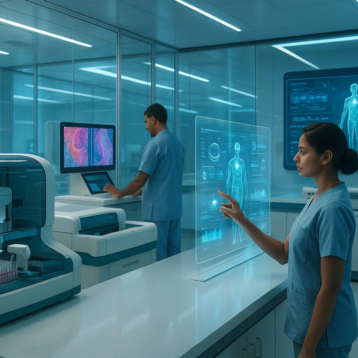
Clinical development has become more data-driven.
Sponsors, research institutions, and CROs (Contract Research Organizations) are expected to bring innovative therapies to market faster while, at the same time, maintaining high standards related to patient safety, regulatory compliance, and data integrity. This is no easy feat. On top of it, studies are becoming increasingly complex and involve multiple sites, remote participants, and vast amounts of information that is generated throughout the trial lifecycle. The bottom line: It is a lot!
Artificial intelligence has emerged as one of the biggest catalysts for change in the medical sector. It is designed to help analyze data more efficiently and uncover insights that would have been difficult to identify manually. However, AI is only one part of the equation. Successful clinical development also depends on specialized digital platforms that can support planning, quality management, documentation, collaboration, and much more.
These technologies enable research teams to work more efficiently, which reduces operational risks and supports informed decisions throughout every stage of a study. Here are 7 digital tools that are helping shape the future of clinical development.

AI Reshaping Clinical Development
AI is influencing nearly every aspect of clinical research, but it doesn’t replace experienced professionals. It helps them process larger volumes of information.
Modern AI solutions can assist in many ways:
- Protocol optimization by highlighting potential design issues
- Identifying suitable participants
- Predicting enrollment challenges
- Detecting unusual data patterns
- Supporting statistical analysis
As clinical datasets continue to grow, AI allows research teams to focus on scientific and operational decisions instead of repetitive manual tasks. However, AI delivers the greatest value when paired with structured clinical systems. Predictive models are, after all, only as reliable as the quality of data they receive. In other words, AI works best alongside platforms designed specifically for clinical operations.
#1. Qlarix for Risk-Based Quality Management RBQM
Risk-Based Quality Management is essential in modern clinical trials. It allows teams to strengthen both compliance and operational efficiency by improving proactive quality oversight instead of reactive monitoring.
WiseCLIN by Qlarix was purpose-built to support this. Unlike general clinical management platforms, it connects Critical-to-Quality factors, risks, controls, Key Risk Indicators, Quality Tolerance Limits, review cycles, and oversight decisions within a single traceable workflow. Real-time dashboards, centralized oversight, and built-in clinical risk libraries help sponsors and CROs identify issues early while maintaining alignment with global guidance like ICH E6 (R3), ICH E8(R1), and ICH Q9. Instead of treating every site and process equally, the Qlarix RBQM solution allows teams to focus attention on activities that have the greatest potential impact on participant safety and study quality.
#2. Electronic Data Capture EDC
Electronic Data Capture platforms like REDCap and Castor EDC replace traditional paper-based processes with secure digital systems that allow investigators to enter, validate, and manage study data in real time.
EDC solutions help:
- Minimize transcription errors
- Improve data consistency
- Accelerate data availability for sponsors and research teams
Many platforms also integrate with lab systems, patient-reported outcome tools, and other research technologies for a more connected data environment throughout the study.
#3. Clinical Trial Management Systems CTMS
Managing a clinical trial involves more than collecting data. Teams must coordinate investigators, study sites, budgets, timelines, regulatory milestones, and vendor relationships across multiple locations.
CTMS bring these operational activities together into a centralized platform. CTMS solutions like Veeva CTMS enable project managers to monitor study progress and allocate resources more effectively. They also help identify potential delays before they impact timelines.
By improving visibility across trial operations, CTMS platforms help organizations maintain control over increasingly complex research programs.
#4. Electronic Trial Master File (eTMF) Platforms
Regulatory documents continue to grow throughout the lifecycle of every clinical study. It is essential to maintain accurate, organized, and inspection-ready records for sponsors operating in global markets.
That’s where eTMF platforms digitize the storage and management of essential study documentation. Instead of relying on fragmented document repositories. Teams can access version-controlled records. They can automate document workflow and even demonstrate compliance more efficiently during regulatory inspections.
This is specifically designed to reduce the administrative burden that can fall on clinical trial sponsors. It improves confidence that the required documentation remains complete and accessible at all times.
#5. eConsent Solutions
Digital consent platforms modernize the process of receiving informed consent by allowing participants to review study information through interactive online experiences rather than relying solely on printed documents.
Many eConsent solutions tend to incorporate multimedia explanations and knowledge assessments before capturing electronic signatures. This is designed to support participant understanding. They also simplify document management by maintaining secure digital records and supporting remote enrollment when necessary.
Ultimately, as decentralized research expands, eConsent will continue to be central to participant accessibility.
#6. Decentralized Clinical Trial Technologies
The growth of decentralized and hybrid clinical trials is transforming how participants can engage with research. Digital technologies support remote monitoring, virtual consultations, and home-based data collection through wearable devices, which means study visits don’t need to take place at a physical site.
Platforms like Medable enable researchers to reduce travel requirements while reaching more geographically diverse patient populations. This has many benefits:
- Improving recruitment
- Increasing participant retention
- Generating more representative datasets
Of course, it’s worth mentioning that not every study can be fully centralized. But there’s no denying that flexible digital infrastructure can help move modern clinical programs and research forward.
#7. Clinical Data Analytics and Visualization
Clinical trials generate enormous quantities of operational and scientific data. It’s important to transform this information into meaningful insights.
Modern analytics platforms provide interactive dashboards that help research teams monitor study performance, identify emerging trends, and support evidence-based decision-making. Visualization tools make it easier to monitor quality metrics and communicate progress across multiple stakeholders. These platforms enable organizations to respond more quickly to operational challenges without maintaining greater oversight throughout.
Looking Ahead
Clinical development is in a new era where intelligent technologies support better decisions at every stage of research. AI is accelerating data analysis and operational efficiency, but long-term success still depends on specialized platforms that provide structure, traceability, and regulatory confidence.
From EDC and decentralized trial tech to RBQM platforms like WiseCLIN by Qlarix, each solution plays a distinct role within the broader clinical ecosystem.
There is no doubt that combining these complementary technologies is the key to improving study quality and bringing innovative therapies to patients more efficiently.