|

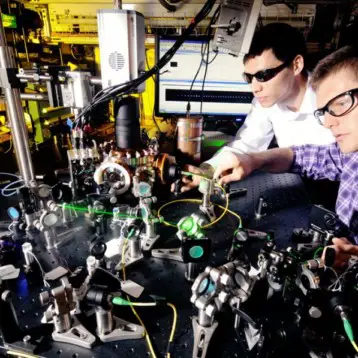
The OBELIX experiment was designed to study the properties of low-energy (slow moving, 1-10 kilo-electron-volt) antiprotons and how they combine with normal matter to produce exotic atomic states. When one of the antiprotons met a molecule of gas and annihilated with one of the molecule’s protons, detectors picked up the new particles produced, allowing the team to pinpoint each annihilation event in space and time.
The annihilation events have been clustered into two groups. The main group represented antiprotons being captured and annihilated by gas molecules as the particles traveled along the walls of the cylinder. A second, more puzzling group of annihilations, which occurred slightly later in time and non adjacent to the walls, has been stumping scientists.
Now, the researchers have reported that they’ve solved the mystery of the second group of annihilators by modeling the presence of the back wall of the aluminum cylinder. Instead of instantly annihilating when they antiprotons hit the wall, about a quarter of the low energy antiprotons striking the wall reflect and travel straight back into the gas located in the center of the cylinder, where they later annihilate.
|

If the antiprotons were moving fast, they would fly right through most atoms, until they finally encountered a nucleus in a nearly direct hit for annihilation. When a relatively slow moving charged particle is fired at a stationary atom, the positively-charged nucleus can deflect it from its course. A slow-moving antiproton, as in the OBELIX experiment, is frequently deflected by the pull of each nucleus so it gets bounced around until it eventually “forgets” the direction it was headed and has a good chance of popping back out, although it may still annihilate somewhere in the wall.
Ryugo Hayano, an expert on low-energy antimatter interactions at CERN, thinks the result, while at first surprising, is solid. “People don’t realize such obvious things until you actually encounter some phenomena and think very hard about them,” he says.
TFOT previously reported about a new antimatter engine design which will require only a few milligrams of positrons to send a spaceship to Mars.
More about OBELIX and the current research can be found on the American Physics Society website.