|

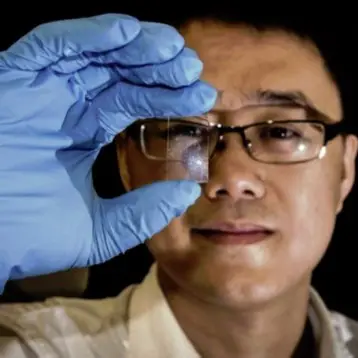
Professor Steven Prawer and a team of scientists from the University of Melbourne’s Department of Physics have managed to manufacture nano-diamonds using nothing more than a common furnace. They are now working to exploit a unique property of these nano-diamonds to create a quantum computer.
Quantum computers make direct use of quantum mechanical phenomena, such as superposition and entanglement, in order to manipulate data. In a classical (or conventional) computer, information is stored as bits. However, in a quantum computer, data is stored as qubits (quantum bits).
|

Pure diamonds contain only carbon atoms and are transparent. Any impurities will usually give them a variety of colors. The impurity in these nano-diamonds is a single nitrogen atom that has ‘kicked out’ one of the carbon atoms. The nitrogen atom creates what is known as the color center, or NV center (Nitrogen Vacancy center) in a diamond. This center has a spare electron that has two possible states: it is either ‘excited’ or ‘ground’ (unexcited). Researchers at the Australian National University have shown that these two states of the electron have the potential to serve in the same manner as 1 and 0 serve as the two states in binary programming. Meaning, an analogy to the ‘true’ and ‘false’ states could be created.
The importance of this discovery is that computing using nano-sized materials may serve as a basis for the creation of future quantum computers. As opposed to the semiconductors currently being used in computers, the new carbon-based nano-diamonds may lead to the implementation of the currently theoretical model of quantum computers.
TFOT has covered the Graphene Paper, paper that is tougher than a diamond and lighter than most metals, and the development of a super-hard material, which is hard enough to scratch a diamond and yet fairly cheap and simple to manufacture. Another related story concerns the D-Waves Systems‘ “demonstration” of a 28-Qubit Quantum Computer. You can learn more about quantum computers in Dr. Boaz Tamir’s series of columns.
More information about the Nano-sized Diamonds Project can be found here.