Feedback Form
   
Add to Google
Nanofibers to Create Self-Cleaning Windows Nanofibers to Create Self-Cleaning Windows
Monday, October 08, 2007 - Avner Yanai
Home >> News >> Nanotechnology
  Peralink
A group of Ohio State University scientists, headed by Dr. Arthur J. Epstein, found that fibers of different heights and diameters can be used to engineer materials with different properties. The scientists also discovered how exposing the fibers to different chemicals can change the fiber's behavior. The findings from this research project may have a variety of potential applications, including the production of self-cleaning surfaces, transparent electronic devices, and biomedical tools that manipulate strands of DNA.

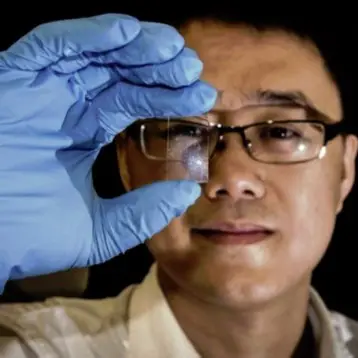
Scholar Nan-Rong Chiou places a drop of water on a plastic surface covered with microscopic fibers. Photo by Jo McCulty, courtesy of Ohio State University 
Scholar Nan-Rong Chiou places a drop
of water on a plastic surface covered
with microscopic fibers
(Credit: Ohio State University)
The Ohio State University group succeeded in growing nano-scaled Polyaniline fibers on surfaces.
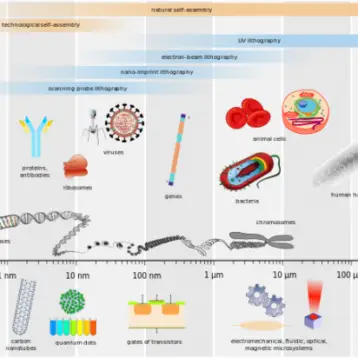
The fibers, which are not visible with the naked eye, can dramatically alter the properties of the surface on which they are grown, resulting in many new and exciting applications. The diameters of the tips of the nanofibers can be controlled within a 10nm-40nm range, and the length can be controlled within a 70nm-360nm range. Using nanofibers, the group developed different kinds of surfaces - some are water-repellent, some attract water, and some even repel oil and dirt. Windows made in this way could stay cleaner for much longer periods of time, as dirt will not stick to them. On the other hand, water attracting surfaces could be used as anti-fog coating (useful for car windshields and windows), seeing as the attraction of the water drops to the surface will cause them to flatten over it uniformly.

A very different application of these fibers could be in DNA interaction research. The scientists put droplets of water containing DNA on a water-attracting surface and found that the DNA strands uncoiled. Epstein said to the Ohio State University Press that scientists could use the fibers as a platform for studying how DNA interacts with other molecules. They could also use the spread-out DNA to build new nanostructures.

 A scanning electron microscope image of plastic dots deposited  on a sheet of transparent film (Credit: Ohio State University)
A scanning electron microscope
image of plastic dots deposited
on a sheet of transparent film
(Credit: Ohio State University)
Another application has to do with transparent plastic electronic devices. Much of the research conducted by Epstein focuses on polymers that conduct electricity, which in the process of conducting electricity light up or change colors. Depending on the choice of polymer, the nano-fiber surface can also conduct electricity. The researchers were able to use the surface to charge an organic light-emitting diode (OLED), an achievement that may pave the way for transparent plastic electronic devices.


TFOT recently covered a different research project that was conducted in the Gent University in Belgium. The findings from the Belgian research product may enable production of electronic devices that are not only transparent but are also stretchable and washable. On another related issue, Sony recently announced it will start selling the first commercial OLED-based TVs in Japan this December.

More information on the new nanofiber research can be found on the Ohio State University research news and in Nature Nanotechnology.

Further discussion of the Nanofibers and their different applications can be found on the TFOT forums.


Related News New Nanoscale Technology for Memory Storage New Nanoscale Technology for Memory Storage High Speed Carbon Nanotube Based Chips High Speed Carbon Nanotube Based Chips

Related Pictures Molecular Gear at the Nanoscale Molecular Gear at the Nanoscale Tuning Graphene's Nature Tuning Graphene's Nature

Other Articles Artigo – VIA’s DIY Micro-PC Artigo – VIA’s DIY Micro-PC Cybook Gen3 e-Book Review Cybook Gen3 e-Book Review


Comments & Replies (3)
OU vs. OSU   (10/09/07 - 7:45 - by Sembar)
Ohio State University and Ohio University are two different
institutions though both are part of the state university system of
Ohio.

This is an important point and the article should be amended.
Fixed   (10/09/07 - 15:55 - by Iddo Genuth)
Thank you.
NANOTECH for self cleaning windows   (03/16/10 - 10:49 - by Joe)
is nanotech already in use to apply coating to have self cleaning
windows and solar panels?

Add a New Comment
Your name:   0/20
Subject:  0/30
Your Comment:  0/999
Type the following letters: Visual CAPTCHA
Please keep your comments related to the above item's topic. TFOT reserves the right to delete any unrelated comment without notice.

Picture Of The Day
NVIDIA Unveils Fermi-Class Quadro GPUs

Video
Breast Cancer Symptoms

Site Of The Week
Galaxy Zoo
Galaxy Zoo

Personal Column
Detroit’s Dream of Aircraft Production
Dr. Daniel Uziel
Detroit’s Dream of Aircraft Production
Terms Of Use | Privacy Policy | Contact Us | Advertise With Us | Site Profile
Copyright © 2007 The Future of Things. All rights reserved.