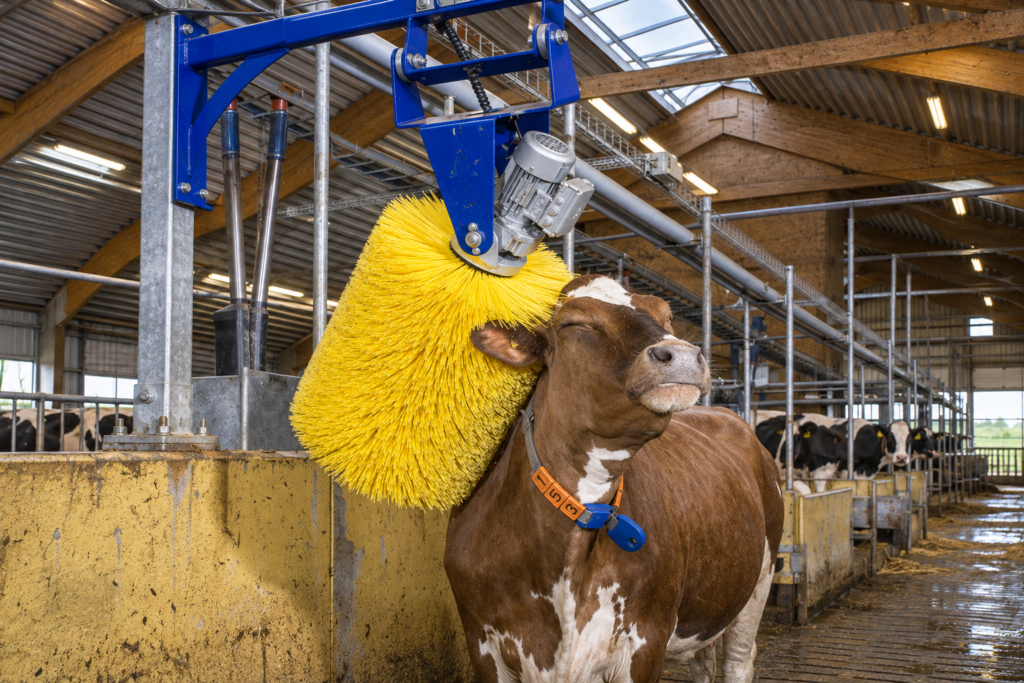
In a dairy barn, a cow can walk up to a suspended brush, press against it and start grooming without a worker operating the equipment. The interaction looks simple. Behind it is a system that must respond to an animal’s movement, maintain suitable contact and stop safely when that contact ends or resistance becomes excessive.
Automated grooming brushes show how farm technology can support a natural behaviour through mechanical design. They also raise a useful question: what makes a brush accessible and comfortable enough for cows to choose to use it?
What Happens When a Cow Touches the Brush?
In many powered designs, the brush hangs from a pivoting arm. When a cow pushes against it, the arm moves and a switch or sensor activates the motor. A gearbox drives the bristled cylinder while the arm follows the cow’s position. The animal controls where and for how long it makes contact.
Control features vary by machine. Some reverse the direction of rotation to distribute bristle wear. Some stop after a set period without contact; others monitor resistance and stop if the brush is obstructed. These are conventional control functions. An automatic cow brush does not need artificial intelligence to detect contact and rotate.
The pivot is as significant as the motor. A brush that can swing gives the cow access to body areas that are difficult to reach with a fixed scratching surface. Its mounting must also leave room for the animal to approach, reposition and move away.
Does Brush Movement Affect How Cows Use It?
A 2026 study in the Journal of Dairy Science tested three brushes with similar physical features but different movement: one swung and rotated, one swung without powered rotation, and one remained stationary. Fourteen cows had access to all three during controlled sessions.
Ten cows spent the most time using the swinging, rotating brush. Yet the researchers also found that both swinging designs were used for grooming the back and rump much more than the stationary brush. The fixed brush was used mainly for the head. Individual preferences varied, and the study’s small group does not establish one ideal design for every herd.
The finding points to an engineering consideration: allowing the brush to move with the animal can change which body areas it can reach. Rotation adds another form of contact, but its value must be judged alongside the brush’s mobility and the cow’s behaviour.
The Bristles Are Part of the Mechanism
The motor and pivot provide movement; the bristles determine how that movement feels at the coat. Filament diameter, exposed length, density and roller profile all influence contact. A change in any of these can also change drag on the drive system.
Brushes may be cylindrical, contoured or assembled from replaceable sections. For a replacement roller, matching the outside diameter alone is insufficient. The core, shaft connection, working length and profile must fit the existing machine. Stiffness and weight also deserve review because a new roller should operate within the equipment’s intended load and safety limits.
Wear is more than a cosmetic issue. Flattened or missing bristles can change the contact surface, while damaged sections or exposed support parts call for inspection. Bearings, mounting hardware and the drive should be checked when a brush develops unusual noise or unstable rotation. Suppliers of cow grooming brushes and replacement rollers therefore need machine details or an approved drawing to assess a replacement.
Could a Grooming Brush Provide Useful Data?
A powered brush can record when it rotates, but rotation alone cannot identify which cow used it. In a 2024 PLOS ONE study, researchers combined brush-rotation records with RFID or camera-based identification to estimate individual use in a group of dairy cows.
That is a research application, not a standard feature of every grooming machine. It also does not turn brush use into a diagnosis. An animal’s activity can be affected by brush location, access, social interactions and individual preference. Any change would need to be interpreted with other farm observations.
The immediate value of an automated brush is more direct: it gives cows a grooming point they can use voluntarily. Its effectiveness depends on the whole installation—movement, bristle contact, controls, maintenance and access within the barn.