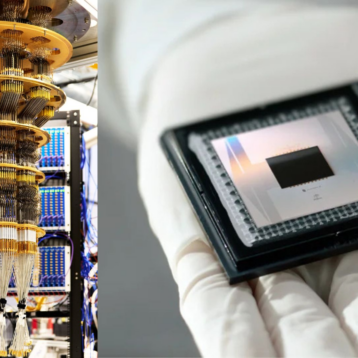
Uzi Vishkin and his University of Maryland colleagues have succeeded in designing a computer with 64 parallel processors, and have defined a suitable programming environment, fitting for performing parallel tasks.
Throughout the last decades, clock speed improvement in desktop computers has been achieved by minimizing the transistor’s size. As Moore’s Law dictates, every 18 – 24 months the number of transistors per surface unit will be doubled. According to that, an increase in clock speed and computer performance should be achieved. However, the clock speed curve, which shot breathtakingly upward during the nineties, has plateaued for some time now. Also, Moore’s law is expected to eventually reach its limit due to physical limitations, and clock speed enhancement by miniaturization will not be possible. Computer performance enhancement could be achieved by introducing parallel computing. In this manner tasks will be distributed among multiple processors, as opposed to current desktops, in which each process is executed serially.
In an interview to the University of Maryland Press, Vishkin explained the advantage of parallel processing in the following way:
"Suppose you hire one person to clean your home, and it takes five hours, or 300 minutes, for the person to perform each task, one after the other. That’s analogous to the current serial processing method. Now imagine that you have 100 cleaning people who can work on your home at the same time! That’s the parallel processing method."
This parallel computing philosophy made it possible for Vishkin to build a supercomputer with components operating at the clock speed of just 75 MHz. The prototype (seen in the above photograph) is capable of computing at speeds up to 100 times faster than current desktops, and theoretically could be reduced to the size of a fingernail when it is in mass production.