Feedback Form
   
Add to Google
New Super-Hard Material Developed New Super-Hard Material Developed
Wednesday, May 02, 2007 - Iddo Genuth
Home >> Picture Of The Day >> General Science
  Peralink
New Super-Hard Material Developed
Related Pictures
Biosphere 2 to Live On
Diving to the Bottom
Scientists from the University of California, Los Angeles (UCLA) have developed a novel material which is hard enough to scratch a diamond yet fairly cheap and simple to manufacture. The rhenium diboride compound developed by the UCLA scientists may have future applications in precision instruments, scratch-resistant coating and metal cutting tools.

Synthetic diamonds, along with several other super-hard materials, such as cubic boron nitride used for cutting steel, have been manufactured for years. However, despite their usefulness, the complex and expensive production of these materials, which requires artificial generation of the ultra strong pressures under which natural diamonds are formed continues to be a major drawback.  

UCLA scientists working under Professor Richard B. Kaner decided to try a different approach to creating super-hard materials. According to Kaner there are two ways to produce super-hard materials that are resistant to shape deformation or "ultra-incompressible", a necessary condition for hardness. One way is to imitate natural diamond formation by combining carbon with boron or nitrogen so as to maintain short bonds. The second way is to find metals that are already incompressible and try to make them hard. Kaner and his team chose the second method and worked on making a naturally soft and incompressible metal harder.   

The team put a mixture of rhenium and boron powder in a furnace and ran a large electric current through it. This quickly melted the materials, allowing the formation of small ingots, just several centimeters long. The result is an ultra-hard material with a relatively low-energy production process, which is fairly inexpensive to produce in large quantities. Although the material is not quite as hard as a diamond, it is still very hard and can be used for a variety of applications. 

More information on the rhenium diboride can be found on the UCLA website.  

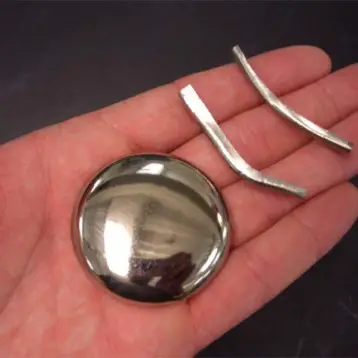
Image: a sample of rhenium diboride - ultra-hard material (Credit: Richard B. Kaner/Jonathan B. Levine/UCLA).

Related Articles 2008 in Science, Medicine and Space 2008 in Science, Medicine and Space 2007 In Science, Medicine and Space 2007 In Science, Medicine and Space

Related News Carbon Nanotubes Dangerous to the Environment Carbon Nanotubes Dangerous to the Environment Sex, Sharks and Cancer Sex, Sharks and Cancer

Other Columns The Wave That Changed Science The Wave That Changed Science Don't Burn the Cat Don't Burn the Cat


Comments & Replies (2)
Super Hard material   (03/15/09 - 20:20 - by Robert Ausman)
how is the material applied to a substrate?? How thick can it be
applied?
physics   (04/14/09 - 0:45 - by mozahar)
good but more information abuot application should give

Add a New Comment
Your name:   0/20
Subject:  0/30
Your Comment:  0/999
Type the following letters: Visual CAPTCHA
Please keep your comments related to the above item's topic. TFOT reserves the right to delete any unrelated comment without notice.

Picture Of The Day
Microsoft Arc Notebook Mouse

Video
Nostalgia: The Atari Wallet

Site Of The Week
Galaxy Zoo
Galaxy Zoo

Personal Column
Detroit’s Dream of Aircraft Production
Dr. Daniel Uziel
Detroit’s Dream of Aircraft Production
Terms Of Use | Privacy Policy | Contact Us | Advertise With Us | Site Profile
Copyright © 2007 The Future of Things. All rights reserved.