Feedback Form
   
Add to Google
Data Stored in a Bacteria DNA Data Stored in a Bacteria DNA
Thursday, April 12, 2007 - Iddo Genuth
Home >> Picture Of The Day >> General Science
  Peralink
Data Stored in a Bacteria DNA
Related Pictures
Diving to the Bottom
Programmable Bending Polymers
A research team from Japan was able to store data on the DNA of a bacteria. Although this breakthrough doesn't seem to have any immediate applications it might be an important step in the development of future biological computers. Biological computers will be able to move inside our bodies fixing problems and helping the body's immune system fight disease.

Professor Masaru Tomita, Director Institute for Advanced Biosciences, in Keio University and his team were able to encode Albert Einstein's famous "E equals MC squared" equation and "1905" the year the Nobel Prize-winning physicist published the special theory of relativity into the DNA of a living bacteria. It is believed that since the DNA of living creatures is so immense it is possible to implant information in it in a way that will not affect the creatures and might pass on to future generations. 

In this way storing information inside a bacteria might prove to be a sort of "massage in a bottle" for future generations who might be able to read this data in hundred maybe even thousands of years. Since random mutations occur in the genome of living organism from time to time it is imperative that scientists will integrate some sort of error correction mechanism (such mechanisms currently exist in many optical and magnetic media today). The simplest form of error correction mechanism will be to implant the same code in several different locations in the organism DNA and compare the different segments. The problem with such simple mechanism is that after a large number of generations/mutations, all of the information might be corrupted and there will be no way to identify the correct information. If and when saving data inside DNA will become more widespread and have useful applications more advanced methods of error corrections will surly be developed. 

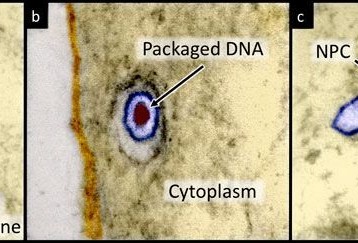
Image: Professor Masaru Tomita showing images of parent bacteria his team used for the research at his laboratory (Credit: AP Photo/Koji Sasahara).

Related Articles 2007 In Science, Medicine and Space 2007 In Science, Medicine and Space 2008 in Science, Medicine and Space 2008 in Science, Medicine and Space

Related News Superconductor is Virtually Immune to Magnetism Superconductor is Virtually Immune to Magnetism Do Monkeys 'Pay' for Sex? Do Monkeys 'Pay' for Sex?

Other Columns Jet Engine Development in Germany Jet Engine Development in Germany You, Grandpa, and Time Travel Paradoxes You, Grandpa, and Time Travel Paradoxes


No comments have been posted for this item.

Add a New Comment
Your name:   0/20
Subject:  0/30
Your Comment:  0/999
Type the following letters: Visual CAPTCHA
Please keep your comments related to the above item's topic. TFOT reserves the right to delete any unrelated comment without notice.

Picture Of The Day
Floating Jelly Hat
Floating Jelly Hat

Video
Paralysed Rats Sprint

Site Of The Week
Galaxy Zoo
Galaxy Zoo

Personal Column
Detroit’s Dream of Aircraft Production
Dr. Daniel Uziel
Detroit’s Dream of Aircraft Production
Terms Of Use | Privacy Policy | Contact Us | Advertise With Us | Site Profile
Copyright © 2007 The Future of Things. All rights reserved.