Feedback Form
   
Add to Google
Nanowire Batteries to Hold 10 Times More Power Nanowire Batteries to Hold 10 Times More Power
Friday, February 29, 2008 - Roni Barr
Home >> News >> Nanotechnology
  Peralink
A team of researchers from Stanford University, led by Yi Cui, assistant Professor of Materials Science and Engineering, have recently succeeded in reinventing the rechargeable lithium-ion (Li-ion) batteries used in laptops, iPods, cell phones, cameras, and other modern electronic devices. Their new technology uses silicon nanowires to produce ten times the amount of electricity of a comparable Li-ion battery. This product may prove to be very attractive not only to gadget manufacturers, but also to electric car manufacturers, to people in homes and offices that use stored energy generated by rooftop solar panels, and to many others.

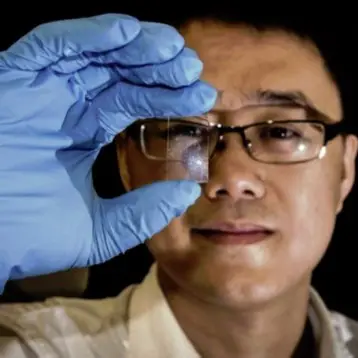
Professor Yi Cui (Credit: Stanford University) 
Professor Yi Cui
(Credit: Stanford University)
The electrical storage capacity of a Li-ion battery is limited by how much lithium can be held in the battery's anode. Typically, the anode is made of carbon, due to the drawbacks of using silicon for this purpose. When silicon is placed in a battery, it absorbs positively charged lithium atoms as it charges, and then shrinks during use as the lithium is drawn out of the silicon. This repeated cycle of expanding and shrinking pulverizes the silicon, which causes the general degradation of the battery. 

Professor Cui and his team solved this problem by using silicon nanowires grown on a stainless steel substrate. Once stored in the battery, the wires can inflate up to four times their original size when being charged, and do not fracture when the lithium is drained out of them.  

Photos taken by a scanning electron microscope of silicon nanowires before (left) and after (right) absorbing lithium (Credit: Stanford University) 
Photos taken by a scanning
electron microscope of silicon
nanowires before (left) and after
(right) absorbing lithium
(Credit: Stanford University)
Cui is considering establishing a company or reaching an agreement with a battery manufacturer for distributing the technology. Manufacturing the nanowire batteries would require "one or two different steps, but the process can certainly be scaled up," he added. "It's a well understood process." 

TFOT has covered several new advanced battery technologies, including Li-ion nano batteries that are considered to be much safer than existing batteries developed by researchers at the Tel Aviv University. A different technology developed by researchers at the University of California allows printing flexible Carbon Nanotube (CNT) based batteries

More on the super Li-ion batteries can be found on Stanford's website.

Related News Nanosoccer - a Match under the Microscope Nanosoccer - a Match under the Microscope New Nanoscale Technology for Memory Storage New Nanoscale Technology for Memory Storage

Other Pictures Evidence of Water in Moon's Interior Evidence of Water in Moon's Interior Tesla Roadster – Electric Sports Car Tesla Roadster – Electric Sports Car

Other Articles 2008 In Technology 2008 In Technology Mind Controlled Bionic Limbs Mind Controlled Bionic Limbs


No comments have been posted for this item.

Add a New Comment
Your name:   0/20
Subject:  0/30
Your Comment:  0/999
Type the following letters: Visual CAPTCHA
Please keep your comments related to the above item's topic. TFOT reserves the right to delete any unrelated comment without notice.

Picture Of The Day
Micro-Flying Robot
Micro-Flying Robot

Video
Hottest Water on Earth

Site Of The Week
Patently Silly
Patently Silly

Personal Column
Jet Engine Development in Germany
Dr. Daniel Uziel
Jet Engine Development in Germany
Terms Of Use | Privacy Policy | Contact Us | Advertise With Us | Site Profile
Copyright © 2007 The Future of Things. All rights reserved.